Industrial Paperboard Converting for Packaging Production
Introduction: The Strategic Role of Paperboard in Modern Packaging
Industrial paperboard converting is one of the pillars of the modern day packaging economy. With rapid adoption of sustainable and efficient format by global industries, paper packaging and paperboard packaging are in place of rigids, multi-material structure, and plastics. FMCG and pharmaceuticals to e-commerce and industrial goods, companies are reconsidering the manner in which the packaging materials are obtained, developed and how they are transformed into a solution.
To the B2B stakeholders such as packaging manufacturers, raw material suppliers, machinery provider and the owners of a brand, the industrial paper converting process to produce packaging is not just a technical issue. It is a strategic ability that determines the cost management, sustainability rates, efficiency, and regulatory standards. The move toward high volume paper packaging production systems, further justifies the scalable, automated and precision-focused operations.
This article examines the industrial environment of paper converting to packaging, machinery, manufacturing processes, quality control, sustainability issues and innovations of the future of paperboard packaging manufacturing.
Understanding Industrial Paper Converting
Industrial converting of paper means the process of changing raw paper or paperboard in the form of rolls and sheets into practical packaging parts. The elements of these elements encompass folding cartons, corrugated boxes, rigid boxes, sleeves, partitions, and inserts and specialty industrial packaging materials.
It normally starts with jumbo rolls or sheets that are provided by paper mills. These materials are designed to certain grammages, coatings and strength properties based on their final usage. Then converting them, they are converted into finished packaging form in a mixture of printing, cutting, creasing, folding, laminating and gluing technologies.
Paper converting to be used in packaging is not on the same plane as general printing as it involves structural engineering as well as the ability to communicate visually. It should be able to satisfy aesthetic needs and also the performance standards of their mechanical strengths like stacking performance, moisture performance and the performance of transportation.
The Industrial Paper Converting Process for Packaging Production
The paper converting process of packaging production has a number of integrated steps, which are all meant to uphold accuracy, consistency, and speed.
The initial phase is a preparation of materials. The paperboard is treated to be at optimum moisture because the changes in the environment can affect the dimensional stability. The storage and handling of the product should be done properly to avoid warping or degradation of the fiber.
The second step is printing and treatment of surfaces. The technologies used in offset, flexographic or digital printing are used based on the volume of production and the need to customize the production. Didactic improvements of surfaces like aqueous coating, UV varnishes or lamination enhance aesthetic appearance and guarding.
This is followed by die-cutting and creasing where sheets are cut into structural designs. Die-cutting systems with complex geometries can be made with advanced die-cutting systems with narrow tolerances. Stretching, this is done to get the fold lines precise and eliminate fiber cracking.
Folding and gluing processes join flat blanks into completed cartons or forms of packaging. Recent folder-gluers consist of an inspection system that can identify misalignment or adhesive irregularities on the fly.
Quality management is incorporated in the workflow. Automated vision inspection systems, barcode checking, and in-line measurement devices assist manufacturers to stay constant and are mostly utilized in high volume paper packaging production systems.
Paperboard Packaging Manufacturing: Engineering for Performance
The production of paperboard packaging is not confined to the shaping of the fiber-based products. It involves structural engineering knowledge to make sure the packages will behave in the actual conditions of logistics.
A significant emphasis is put on strength-to-weight optimization. Simulation software helps manufacturers to create a package that will use the minimum amount of material with compression, burst, and drop-test performance. Lightweighting strategies lower costs of transportation and environmental effects.
A developing field is barrier functionality. Paperboard cannot be wet or greasy but emerging coating and hybrid fiber technologies are allowing paper packaging to be used in food, pharmaceutical, and industrial markets with more demanding performance requirements.
Sustainability certification has also been made a key factor in the procurement. There is the growing demand by businesses that they should be compliant with the international standards of forestry and recyclability. Consequently, the production of paperboard packaging is currently being introduced with traceability functionality that records fiber sourcing and lifecycle information.
Paperboard Converting Machinery for Packaging Manufacturers
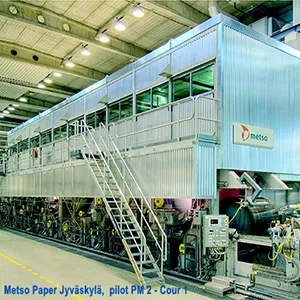
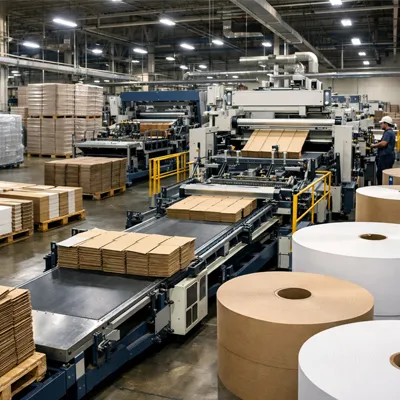
The development of the paperboard converting equipment to the packaging manufacturers has enhanced speed, accuracy and flexibilities by a large margin. Contemporary converting lines incorporate the automation, robotics, and online control systems.
Thousands of sheets are now processed in high-speed die-cutters, and minimum downtime is experienced. Inspection systems are installed at the point of production to identify errors or faulty structures in printing without necessarily stopping the production. Folder-gluers with servo drives allow very fast product format changeovers; less waste is created during set-up transitions.
Material handling is also automated. Palletizers and robotic stackers minimize human intervention, which improves the safety and throughput of the workplace. Further ERP integration renders that planning of production is in consonance with the forecasting of orders and inventory.
The modular type of machinery comes in handy especially to packaging manufacturers serving various industries. With these systems, the operators can alternate between folding cartons, rigid box components and specialty inserts without necessarily having different production lines.
Operational transparency has also been enhanced because of the adoption of Industry 4.0 technologies. Equipment has sensors to measure vibration, temperature, and other performance indicators, which allow to predict maintenance and reduce unforeseen downtime.
High Volume Paper Packaging Production Systems
Large paper packaging production facilities are modeled to satisfy the needs of the multinational brands and e-commerce monopolies. These systems are focused on speed, reproducibility, and reduction of material wastes.
Continuous roll-fed processes are also specific to certain format in large scale operations so that the production cycle is non-interrupted. Recycling systems of waste removal and scrap recycling are automated to minimize fiber loss. Motors and heat recovery units that are energy efficient enhance the sustainability measures and reduce the operating costs.
The data analytics of production are important. Output rates, percentages of defects and resource usage are monitored using real time dashboards. This transparency ensures that plant managers can make timely changes and be profitable.
Another characteristic is scalability. The high volume paper packaging production systems also use facilities with redundant machinery lines to be used during peak and low demand periods without affecting the delivery schedule.
Industrial Packaging Materials and Sustainability Dynamics
The alteration of industrial packaging materials is due to the varying environmental regulations and consumer demands. A new type of paperboard that has come out to compete has been made of renewable source and recyclable nature.
But sustainability in paper packaging is not limited to the source of fibers. The water use, energy consumption and the use of coating such as chemicals is closely scrutinized. To minimize the environmental footprint, converters are investing in closed-loop water systems, integration of renewable energy, and bio-based coating.
Long Producer Responsibility laws in various markets are compelling manufacturers to create packaging design, which is recyclable and without detailed laminates. Consequently, paperboard package solutions made of mono-materials are becoming popular in industries.
Lifecycle assessments are becoming popular in order to show environmental performance. B2B consumers normally demand paperwork of reducing carbon footprint, before giving the go-ahead to supplier alliances.
Supply Chain Integration and B2B Collaboration
Paper converting processes in industries do not operate separately.
They are embedded within complicated supply chains that bond pulp mills, converters, brand proprietors, logistics suppliers and retailers.
Shared planning models are being used. Packaging manufacturers collaborate directly with the owners of the brand in the process of developing the product to maximize their selection of the material and the structure. Designing early will decrease the cost of redesign and minimize time-to-market.
The use of digital platforms improves transparency. The forecasting tools that are shared enable converters to optimize the production schedules according to the seasonal demand changes. Combined supply chain policies are useful in reducing overstocking of inventory and waste in the value chain.
In the case of industrial customers, the reliability of packaging has a direct influence on the operation continuity. Structural failures or delays may cause production lines to be disrupted or even damage goods on transit. Supplier assessment is therefore normally accompanied with manufacturing process audits, quality certification, and contingency planning facilities.
Technology Trends Reshaping Industrial Paper Converting
The concept of technological innovation keeps on setting new trends on the competitive arena of packet converting paper. Digital printing has become popular in the short-run and personalized packaging orders. It does not require printing plates and the setup costs are reduced and it has the ability to incorporate variable data.
Defect detection systems are using artificial intelligence. The machine learning algorithms examine production pictures and detect micro-imperfections which may be missed by the human inspectors.
Coatings and fiber engineering are also advanced and are widening the performance range of the paperboard packaging manufacturing. It is now possible to have water-proof, heat-proof and grease-proof solutions without losing recyclability.
Innovation that is based on sustainability is also gaining momentum. Compostable barrier layers and water based inks are minimising the impact of packaging materials on the environment without compromising on their functionality.
Quality Assurance and Regulatory Compliance
Regulatory compliance is not bargainable in other areas like in the pharmaceutical and food processing industries. Paperboard packaging should be of very high standards in terms of the migration limit, contamination and traceability.
Quality assurance systems normally involve testing of raw materials, monitoring in-process, as well as testing of the final product. Documentation systems also provide that the source of any batch is traceable.
Supplier approval is often subject to safety, environmental management and operational excellence related certifications. These certifications are indications of reliability to buyers in the B2B and enhances the sustainability of business relationships.
Economic Considerations in Paperboard Converting
Minimization of costs is at the center of the industrial decision-making. The cost of materials, energy, and output of labor, depreciation of equipment, all determine total profitability.
The automation has greatly minimized human involvement processes but its capital expenditure on the state of art machines is huge. Calculation of ROI usually takes into account throughput growth, waste lessening and downtime lessening.
Pricing is also affected by the effects of global trade. The cost of pulp and transportation costs may vary and this will affect the economics of paper packaging production. Volatility is mitigated by strategic sourcing and long term contracts with suppliers.
Frequently Asked Questions
What differentiates industrial paper converting from general packaging printing?
Paper converting Industry combines structural engineering, high-speed production and performance testing with printing. It is scaled and resilient-oriented as opposed to being used in decorative purposes only.
How do high volume paper packaging production systems improve profitability?
They involve automation to reduce the unit costs, minimize wastes, increase speed, and stability in quality, which enables manufacturers to serve large demand economically.
What are the sustainability advantages of paperboard packaging manufacturing?
Paperboard has the potential to be renewable and is recyclable and more compatible with compostable coatings. It has the tendency of having a smaller carbon footprint than most other alternative packaging materials.
The Future Outlook
The packaging production converting paperboard used in industries finds itself at a crossroad. The need of packaging materials that are sustainable is increasing in industries. Simultaneously, the efficiency standards are being redefined by the technological advances.
The packaging manufacturers that invest in high-quality paperboard converting equipment, embrace the digital workflow, and adhere to the sustainability framework will not disappear in the global markets. A large-scale operation will probably be dominated by high volume paper packaging production systems, backed with the help of data analytics and predictive maintenance.
Finally paper converting is no longer a back-end manufacturing operation in the industry. It is a tactical facilitator of brand image, regulatory conformity and resiliency of operations. To the B2B stakeholders experiencing the changes in the supply chains and sustainability requirements, understanding how to convert industrial paper into the packaging production process is the key to long-term progress and innovations.
 Our Services
 Media Pack Download
 Newsletters
 Industrial Events