Industrial Paper Finishing & Converting Technologies: From Raw Sheets to High-Value Products
Introduction: Where Paper Manufacturing Meets Market Demand
The paper finishing and converting technology (industrial) is at a key point of intersection between the process of paper manufacturing and its final application. Base paper production is concerned with the preparation of fibers, pulping, and sheet formation where finishing and converting decide the performance of that paper in the real world conditions like packaging, printing, labelling, and wrapping in industries. In the current competitive technology of manufacturing commercial papers, volume is no longer the parameter of value. It is characterised by accuracy, exterior performance, personalization and the capability to comply with varied regulatory and sustainability conditions.
With the increased variety of packaging formats and the growing use of higher functional performance by the brand owners, the paper finishing and converting operations have changed to become highly engineered and automation based operations. The article presents industrial paper finishing technologies described in the B2B context, including machinery, workflow, applications, and an insight into upcoming trends that are influencing paper converting to be used in packaging purposes.
Understanding Industrial Paper Finishing and Converting
The term industrial paper finishing is a combination of post-manufacturing processes that improve the appearance, functionalities, the strength, and appearance of paper. These operations equip paper with printing, coating, laminating or even for direct industrial and commercial use. Paper converting technologies, however, convert big parent reels into finished or semi-finished items which include roll, sheet, carton, pouch, label, or specialty components.
Industrial paper finishing and converting processes fill the gap between the paper mills and the downstream industries. They enable manufacturers to customize the properties of papers based on thickness, smoothness, moisture resistance, printability and structural integrity.
Definition: Industrial Paper Converting Processes
Paper converting processes in the industries entail cutting, folding, coating, laminating, embossing, slitting, rewinding, and shaping paper into useful end products to be used in packaging, printing, and industry.
Role of Finishing and Converting in Paper Manufacturing Processes
With the conventional paper manufacturing process, the emphasis is on the quality of pulp, fiber bonding and sheet consistency. Base paper, however, seldom is market-ready. Paper finishing in the industry includes mechanical treatment, chemical treatment, and thermal treatment which add great value to the products.
To illustrate, the paper without a coating might not be good enough as a barrier layer to food packages. With paper finishing and coating technologies, the same paper can then be made grease and moisture proof or even a heat-sealable material. In a similar manner, converting operations have the dimension accuracy and compatibility with automated filling, labeling, or printing systems utilized by B2B customers.
This is a multi-layered solution that allows the mills and converters to be used across multiple industries with a common base paper grade that allows greater operational flexibility and revenue potential.
Core Industrial Paper Finishing Technologies Explained
The machinery used in finishing paper has developed very fast due to automation, digital control, and in line checking. The calendering is one of the most popular finishing operations that enhance the smoothness and the gloss of the surface by passing pieces of paper through heated or pressure-controlled rollers. The process is necessary to the print-based applications when uniformity of the ink and clarity of the image is crucial.
Another significant type of industrial paper finishing is coating technologies. These systems incorporate either functional or decorative finishes with blade coaters, air knife coaters, rod coaters or curtain coaters. Barrier properties, ink adhesion, brightness, or sustainability can be achieved using paper finishing and coating solutions based on water-based and bio-based formulation.
Embossing and texturing technologies are also not irrelevant especially in high end packaging and specialty paper products. These processes create a more functional grip and shape as well as aesthetic values, without reducing structural integrity, on surface geometry.
Paper Finishing Machinery: Key Systems and Capabilities
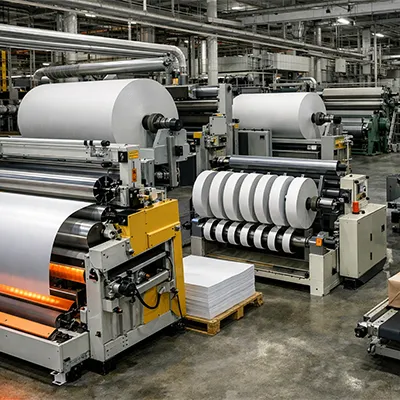
The modern paper finishing equipment is developed to operate at a high speed in continuous mode and tolerances are maintained tight. Machines are usually designed to be modular so that the manufacturer can put several finishing processes in one production line. There are automation systems that control parameters including coating weight, roughness of the surface, the amount of moisture, and roll tension in real time.
In the table below, the most commonly used types of paper finishing machinery and their industrial applications are noted.
| Machinery Type | Primary Function | Typical Applications |
| Calenders | Surface smoothing and gloss control | Printing paper, coated boards |
| Coating Lines | Application of functional or decorative layers | Food packaging, labels |
| Laminators | Bonding paper with films or foils | Flexible packaging |
| Embossers | Surface texture enhancement | Luxury packaging |
| Rewinders | Roll formation and tension control | Industrial reels |
Evolution of Paper Converting Technologies
Paper converting technologies have become less and less mechanical and more labor intensive and have become digitally controlled and high speed systems with short run capability and frequent changeovers. This development indicates increasing needs of customization particularly in the packaging packages involving paper converting.
Slitting, sheeting, die-cutting, and folding are now digitized with the processes being synchronized with the digital print and finishing systems. Paper converting processes that are highly industrialized enable converters to manufacture complex format using various layers like multi-layered cartons, stand-up pouches, and protective wraps with minimal wastage.
This flexibility is especially useful in B2B markets, particularly in food and beverage, pharmaceuticals, logistics or consumer goods sectors where packaging specification is frequently modified on a fairly regular basis either by regulation or branding a change or sustainability efforts.
Commercial Paper Manufacturing Technology and Integration
A technology that is being adopted in commercial paper manufacturing is the convergence of finishing, converting and quality assurance. In lieu of finishing as a downstream operation, frontline manufacturers are integrating finishing and converting operations as single production environments.
This integration decreases the material handling, defects and also decreases the lead times. Online inspection systems reveal surface defects, coating variation or dimensional variations prior to product movement out of the line. The information gathered through these systems is fed into manufacturing execution systems that make it possible to predict maintenance and the use of continuous improvement.
In the case of B2B buyers, this comes in its form of consistency in quality, traceability, and adherence to industry standards.
Paper Finishing and Converting Processes in Packaging Applications
One of the most rapidly developing areas of the industry is paper converting to use in packaging. The abandonment of plastic has increased the need of paper based solutions that have a similar barrier and strength property.
The mono-material paper packaging is now achievable through paper finishing and converting processes that increase the resistance of moisture, grease, and oxygen. Elevated coatings and laminations boost food safety and do not impact on recycling streams.
Sacks, wraps and protective materials in industrial packaging converting technologies are heavy-duty paper converting technologies that yield high load carrying capacity and durability. The solutions find extensive application in cement, chemicals, agriculture and building industries.
Industry Checklist: Selecting the Right Finishing and Converting Partner
In comparing industrial paper finishing technologies, B2B customers tend to evaluate suppliers in terms of capability of the process, as well as scalability and readiness to comply. The main things are usually the rate of production, the ability to coat flexibility, the level of automation, the compatibility with sustainability, and familiarity with industry specific requirements.
The partnerships will be based on technical cooperation instead of transactional provision which will be successful, particularly with the increased application of packaging and paper products.
Sustainability and Innovation in Industrial Paper Finishing
The concept of sustainability has come to be the qualitative element in the development of industrial processes in paper finishing and converting. Machinery, Coatings, Waste, nowadays, it is standard to have energy efficient machinery, water based coating and waste reducing technologies which are not the differentiators.
Advances in bio-based coatings and fiber engineering enable the manufacturers to substitute the plastic layers without compromising the performance. Simultaneously, online process control helps to decrease overproduction and waste of materials, which helps to achieve environmental and cost-efficiency objectives.
The pressure by the regulation authority and brand commitments are continuing to fuel further investment on sustainable commercial paper manufacturing technology in the global market.
Frequently Asked Questions: Industry Snapshot
What is the difference between paper finishing and paper converting?
The process of paper finishing improves the appearance and practicality of the paper and paper converting is the conversion of a finished paper into a useful product be it packaging, roll or sheet.
Why are paper finishing and coating processes critical for packaging?
They offer necessary barrier, strength and printability properties needed in food safety, durability and branding.
How do paper converting technologies support customization?
The converting systems of the modern world allow them to quickly switch formats, make small production batches, and have a high degree of dimensional control, which are necessary to provide customized packaging.
Are industrial paper finishing technologies compatible with sustainability goals?
Paper finishing and converting technologies have ceased to be part of the value chain of paper manufacturing. They are tactical facilitators, which dictate product performance, market relevance and profitability. With the continued search to find sustainable and high-performance replaceable alternatives to plastic by industries, the presence of the advanced paper finishing machinery and industrial paper converting processes will continue to grow.
Conclusion: The Strategic Value of Finishing and Converting Technologies
Paper finishing and converting technologies have ceased to be part of the value chain of paper manufacturing. They are tactical facilitators, which dictate product performance, market relevance and profitability. With the continued search to find sustainable and high-performance replaceable alternatives to plastic by industries, the presence of the advanced paper finishing machinery and industrial paper converting processes will continue to grow.
In B2B stakeholders, industrial paper finishing technologies can be described using practical terms that will be useful in enabling an informed decision of both investment and sourcing. The future of paper is not only the way it can be made, but to how it is also completed, transformed and to suit the changing market demands.
 Our Services
 Media Pack Download
 Newsletters
 Industrial Events