Industrial Paper Cutting Machines and Finishing Tools
Introduction: Precision at the Core of Modern Paper Converting
In the modern very competitive manufacturing environment, paper conversion and finishing processes require speed, accuracy and uniformity. Businesses are dependent on high cutting technologies to achieve tight tolerances and large volume packaging and labeling, printing and publishing. The development of the paper cutting machine started as manual radical equipment on a bench system to digitally controlled equipment has changed the productivity and quality standards within industries.
Industrial purchasers, plant administrators, and procurement professionals are definitely on the lookout of solutions to their needs which are compatible with automation plans, sustainability objectives, and lean manufacturing designs. Investing in an industrial paper cutter to be used in packaging or investing in industrial paper cutting machines to produced large quantities of paper, the decision-makers need to put into consideration performance, throughput, safety and long-term operational efficiency.
This article provides an overview of the role of industrial paper cutting machines and finishing tools in the modern manufacturing industry, the main technologies, its implementation, selection criteria, and the development trends of the industry.
Understanding Industrial Paper Cutting Technologies
A paper cutting machine is essentially a machine that is meant to trim, slice, or cut paper materials to their exact dimensions. Industrial systems, however, are very different as compared to their commercial or office grade. They are designed to be durable, to be able to run continuously, and also be able to be incorporated into automated production lines.
A cutting machine used in industry is normally fitted with hydraulic or servo drives, programmable logic controller, and back gauges of high precision. These characteristics guarantee the use of proper repeat cuts even when the workloads are high. In major production plants, an industrial paper cutter needs to have micrometer precision in thousands of sheets per hour.
One of the most prolifically used configurations has been the guillotine paper cutter which is still in use in the industrial world. Its vertical cutting system offers straight with clean cuts and the clamping forces are high thus making it suitable when large quantities of processing are required. In bulk material plants, a large paper cutter with strengthened frames and longer than normal cutting widths will enable the operator to handle large formats with ease.
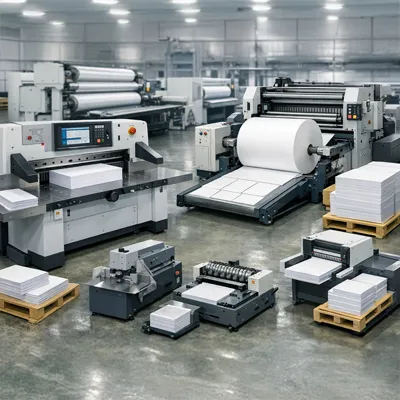
In the meantime, some specific systems like the paper roll cutting machine and paper sheet cutting machine handle various processes of converting. Roll-fed systems are typically utilized in packaging and tissue production whereas sheet-fed systems prevail in commercial printing as well as carton production.
Guillotine Paper Cutters in High-Volume Operations
The guillotine paper cutter used in large volume paper processing has been highly advanced with automation and computerized controls. Mechanical models have been substituted by programmable systems which store cutting sequences, optimize the movement of the blades and minimize wastage of materials.
Guillotine cutters are used in packaging and bookbinding operations to work with stacked reams and it is highly efficient. Better clamping systems lead to no material movement in cutting which produces square edges and regular production. Other large models of paper cutters have touchscreen support, safety light curtains, and IoT connectivity to provide real-time performance information.
Quick changeovers can be facilitated by programmable features against manufacturing plants that handle various SKUs and short production batches. Job parameters can be saved allowing operators to recall them and save time, improve production flexibility. In enormous plants, this feature facilitates just in time production and lean inventories.
Paper Roll Cutting Machines in Converting Industries
The paper roll cutting machine is crucial in the industries of flexible packaging, corrugated board, hygiene products and specialty papers. In contrast to sheet-based systems, roll cutting solutions are also continuous and large roll unwinds get sliced into thinner widths or a definite length.
Servo powered knives and automated tension controls are used in high speed production facilities, where a consistent high cut is required and the material integrity should not be impaired. Many manufacture plants use paper roll and sheet cutting machines with automatic core positioning, edge trimming systems and waste removal conveyors.
Specifically, roll-to-sheet systems are useful in the packaging plant where bulk rolls have to be converted into standard sheet format. Manufacturers combine roll and sheet cutting in one line and as a result, minimize handling processes and enhance throughput.
Paper Sheet Cutting Machines for Precision Applications
Paper sheet cutting machine is a necessity in printing plants, carton producing plant and specialty paper processors. These systems process pre-cut sheets, cutting them to the final sizes needed by the subsequent processes, like folding, binding, laminating or die-cutting.
The sheet cutters of the modern era are fitted with digital back gauges that automatically change the positioning depending on programmed entries. Rapid cutting cycles along with optical alignment systems can increase repeatability and reduce scrap rates.
In commercial printing work, it is all about precision. The tiniest of deviations may impact on registration and finishing quality. Thus, the industry paper cutter intended to be used in sheet work should provide the same pressure and the blade sharpness throughout the long production cycles.
Finishing Tools Complementing Cutting Operations
Paper cutting machines that are used in industries are hardly used independently. They are a part of more extensive finishing processes which incorporate folding, creasing, perforating, laminating and binding. Finishing tools are also value-added since they are used to turn raw cuts into finished products.
Cracking in thick substrates is avoided by increasing and scoring tools. Perforation systems allow easy tear-off capability of tickets, forms and packaging inserts. The sheet before cutting is placed in an automated stacking and jogging system so that it is uniform.
Paper roll cutting machines are often used together with finishing equipment in packaging production like slitters, rewinders and die cutting units. This is the interrelated method which lessens the use of manuals and encourages the use of high-speed automated lines.
Industrial Applications across Sectors
The large-scale production paper cutting machines in industries cater to various industries. Precision cutting is applied in the packaging industry in support of corrugated boxes, folding cartons and specialty packaging solutions. Even dimensions are needed to achieve structural integrity and fit in automated filling lines.
Guillotine paper cutters are used in the publishing industry to properly trim the books, magazines and brochures. In the case of labeling and specialty printing, roll cutting systems can be used to do narrow-width conversions to adhesive labels and tags.
The hygiene industry manufacturers depend on the use of high speed roll cutters in order to pursue tissue and nonwoven products. Uptime and reliability in such environment have a direct effect on profitability.
Advanced cutting systems are essential in these industries due to the ability to scale operation and be able to maintain tight tolerances.
Key Technical Specifications and Performance Indicators
Buyers of an industrial paper cutting machine put into consideration a number of performance parameters when considering the performance of the machine. Maximum material capacity is dependent on the cutting width and depth. Clamping pressure determines accuracy of cuts and material stability. The material of blades and hardness affect the lifespan and service rate.
Speed of the cycle, portability of memory and compatibility to automation are also essential factors. Throughput in terms of sheets per hour or meters per minute is one of the main performance indicators in high output plants.
It is also vital to comply with safety. The current large paper cutter designs have two-hand operating systems, infrared safety barriers, and the emergency stop system to guard the operators.
The connectivity features, including the ability to integrate with manufacturing execution systems, enable the managers to monitor production indicators and make workflow performance efficient.
Automation and Smart Manufacturing Integration
The industry is being transformed by the introduction of smart machines of industrial paper cutting into the modern manufacturing sectors.
The IoT-based machines will offer real-time diagnostics and predictive maintenance notifications and performance analytics.
With the use of the guillotine paper cutter systems, the centralization of the dashboards allows the plant managers to see the blade wear, motor performance, and the production output. Predictive maintenance helps in reducing the unexpected shutdowns and prolongs the life of equipment.
The efficiency is also improved with automated material handling systems. Unloaders and loaders are robots that save on human work and enhance safety in the work environment. The paper cutting technology is becoming more compatible with the digital transformation plans as the Industry 4.0 is introduced.
Sustainability and Waste Reduction
Sustainability has become a trend in paper processing industries. Efficient cutting minimizes offcuts and wastes of materials, which are cost saving and environmentally responsible.
Complex optimization software is used to generate cutting patterns so that the maximum amount of sheet is used. Automated edge trimming systems in roll processing reduce scrap and increase quality.
Motors and hydraulic systems that consume less power are eco-friendly. Recyclable blade materials and environmentally responsible lubricants are also the subjects of interest to the manufacturers as they enable them to operate sustainably.
Large-scale production of industrial paper cutting machines with high performance enables companies to balance profitability with sustainability goals.
Decision-Making Framework for B2B Buyers
The choice of an appropriate paper cutting machine is a matter of strategic evaluation of the functioning needs. The buyers are to consider production volume, type of materials, the level of automation required, and available floor space.
Guillotine paper cutter on the high volume paper processing is durable and has the same resultant performance in facilities that focus on high volume batch processes. Plants with continuous roll operations can be equipped with sophisticated paper roll cutting machine systems which are coupled with slitters and re-winders.
The cost analysis must take into consideration total cost of ownership as opposed to initial purchase price only. The costs of maintenance, the rate of replacement of the blades, energy use, and downtimes influence the long-term profitability.
Another aspect that affects industrial purchases is the reputation of suppliers, after sales service and availability of spare parts.
Quality Control and Maintenance Practices
It is necessary to check and calibrate constantly in order to maintain optimal performance. The frequency at which to sharpen blades should be in harmony with the intensity of production to maintain quality of cut. Hydraulic systems and servo motors should be checked on regular basis to make sure that they run smoothly.
The operators are supposed to be given adequate training on how to set the machine, safety and maintenance. Preventive maintenance programs minimize unforeseen failure of machinery and increase the life of the machinery.
Automated maintenance alerts become smoother with digital monitoring systems that provide an opportunity to conduct proactive interventions prior to the escalation of the problem.
Emerging Trends in Paper Cutting and Finishing
The future of paper cutting equipment is still determined by technological innovation. Servo-driven systems are more accurate and efficient in power than the conventional hydraulic ones. The use of artificial intelligence is under investigation to streamline the cutting patterns and find abnormalities.
Hybrid machines that can be used to deal with both roll and sheet types give flexibility to the dynamic world of production. Compact modular systems enable manufacturers to increase capacity without making massive changes to the facilities.
The industrial paper cutting machines will continue to be the focus of efficient and scalable manufacturing operations as the global market demands packaging and other specialty print products.
Conclusion: Enabling Scalable Precision
Paper cutting machines and finishing equipment is not just another mechanical equipment in the industrial sphere, it is a strategic asset in the modern manufacturing ecosystem. Businesses need high quality and accurate paper cutting solutions whether they are ready to test the waters by installing a large paper cutter to process bulk sheets or they are ready to install paper roll machines and sheet cutters in their manufacturing plants.
As automation, digital connectivity, and sustainability become the priorities in the industry, the next-generation industrial paper cutters are built with the future of being scalable, efficient and adaptable. Through a keen analysis of technological potential and strategic matching of investments with the operational objectives, manufacturers would be able to increase the productivity and cut down the waste levels, as well as ensure the competitive edge in the fast developing market.
With precision being the hallmark of quality and efficiency leading to profitability, the innovative paper cutting systems are leading in the industrial field.
 Our Services
 Media Pack Download
 Newsletters
 Industrial Events