Smart Printing and Binding for Modern Industry
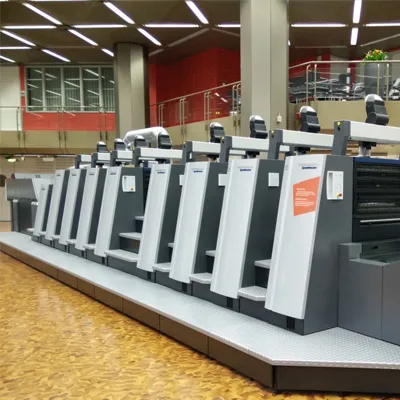
The modern manufacturing environment is changing fast, and industrial printing and binding machines are no longer mere secondary processes; they are the key to efficiency, branding, and productivity. As printing technology develops at a blistering pace, industries are starting to address some additional questions: How far can the automation of printing be taken? Is it true that the manual labour can be fully replaced with automated binding systems? And above all, what will be the future of the integration of printing and binding at the smart factories?
The article delves into the richness of changes that have been caused by the modern-day printing machines and the mechanics of the industrial production binding machines and the new innovations that are being introduced in modern industrial printing systems that are transforming the industries all over the world.
The Shift from Traditional Printing to Smart Systems
Soon, industrial printing used to imply huge and mechanical presses that demanded huge amounts of manpower and time. The production was stable but very slow making it difficult to meet the global demand. As the printing technology began to rise, the industries began to explore the possibilities of the digital workflows and industrial methods of print financing, which pushed to the limits the possibilities of what could be done.
Automation of print has minimized mistakes and enhanced uniformity. In contrast to the old system, the new advanced printing machines liaise with software systems to modify the quality of prints in real time. Industries are now more efficient than ever before when they are coupled with automated binding systems. This dynamic duo not only saves on wastage, but also stipulates that all the products coming out of the line are of the highest quality standards.
Why Binding Still Matters in a Digital Era
There are a lot of questions why, in the world where digital screens reign, it is possible to use physical binding. The reality is in durability, presentation, and compliance. Pharmaceutical leaflets and automotive manuals are still bound documents that cannot be done away with. This is where the interest is greatest: the nature of binding machines in the industrial production does not concern merely clipping or gluing pages. It is concerning accuracy, speed, and uniformity on an industrial level.
The modern binding machines are made to fit well with industrial printing systems. As an example, factories with a high volume of manuals per day use automated binding systems to ensure that production does not fall behind. In the absence of automation, the industries would have to pay millions due to the errors in pagination, alignment or durability. The union of printing technology and industrial print finishing thus, remains dynamic, even in assuring high demand of the businesses in the current markets.
The Mechanics: How Binding Machines Work in Industrial Production
The first question that curiosity starts with is most likely: how do binding machines operate in industrial production? It is actually a rather complicated process. The printed sheets of sophisticated printing machines are first fed automatically. Then the binding machines use adhesives, stitching, or thermal binding depending on the industry demand. Lastly, the product is subject to industrial print finishing procedures, which may include trimming, embossing or laminating to make the product durable and presentable.
Print automation is used in entirely automated plants to synchronize the binder and the printer. With a misprint, the system stops the binding process to avoid the supply of defective products to the market. This demonstrates the fact that printing and binding integration in smart factories will not be convenient only, but in fact, risk management and brand protection.
Market Insights: Growth of Smart Printing and Binding
| Year | Global Market Size for Industrial Printing (USD Billion) | Adoption Rate of Automated Binding Systems |
| 2020 | 120.5 | 35% |
| 2023 | 145.8 | 49% |
| 2025 (Projected) | 180.2 | 65% |
The statistics indicate clearly that there was a high correlation between the increased industrial printing and the increased use of automated binding systems. The gradual transition indicates that the companies are realizing that end-to-end automation is a crucial concept that should be considered and not just concentrate on the printing technology.
The Rise of Advanced Printing Machines
The use of sophisticated printing equipment has not only ceased to provide ink on paper. They currently carry textiles, plastics, metals and even ceramics. The industries being driven by this diversification are as far as packaging up to the automotive industry. They combine with binding machines to produce totally different types of products. Think of custom car manuals, which are printed on-demand and bound in front of the customer as he/she pulls off car.
These are also the machines with built-in AI-controlled sensors and print automation is smarter than ever. They scan irregularities in a print and correct the flow of the ink and raise an alert about the possible problems. Subsequently, industrial print finishes are more trustworthy, and it opens the way to perfect results.
Latest Innovations in Industrial Printing Systems
What do the most recent advances in the industrial printing systems everyone is talking about? Hybrid printing, which is a combination of digital and analog systems, is one of the major advances. This will enable firms to enjoy the economical aspect of printing through analog and have the flexibility of digital processes.
Predictive maintenance in superior printing machines is another invention. A system of sensors constantly checks the condition of the machines, anticipating failures. This reduces down time particularly, when the automated binding systems rely on continuous workflow.
Moreover, with cloud connectivity, remote operators can observe industrial printing lines on any point of the planet. This degree of transparency also supports the argument of printing and binding integration in smart factories.
Integration of Printing and Binding in Smart Factories
Printing and binding of smart factories is one of the most interesting developments. In this case, information moves freely among machines, and no-one causes a bottleneck. In case a print run is changed, binding machines automatically readjust to the changes.
This integration does not only involve efficiency but rather being intelligent. The real-time analytics enable managers to uncover inefficiencies and the AI systems are able to boost the printing technology by continually learning and improving with the production data. The result? Self-correcting, self-optimizing, and self-performing factories that need human surveillance at a minimum level.
The Competitive Edge: Why Businesses Must Invest
In the packaging, pharmaceutical, and publishing industries, the margin of error is very thin. The adoption of high-end printing machines and automatic binding systems will not only provide speed but also provide a competitive edge. An effective system of print automation saves cost, improves quality, and time-to-market.
Additionally, the final product is presentable and structurally sound with the help of industrial print finishing, and this makes the consumer more trusting. Firms that fail to adopt the recent advances in industrial printed systems are likely to lose competitive advantage to other, more agile firms that have adopted the digital transformation.
Curiosity Corner: What’s Next for Industrial Printing?
What is the future based on the fact that printing technology has already moved beyond the mechanical presses to smart machines operated by artificial intelligence? The speculations go as far as complete self-governing printing manufacturing industries that do not need human interventions, to an eco-friendly binding adhesive that was made with sustainability in mind.
Consider having the binding machines that vary the adhesive composition according to the type of paper or the weather. Imagine the automated binding systems that recycle the misprints automatically and reintroduce it into production without interruption. Such opportunities raise the question of the extent to which smart factories can be integrated to combine printing and binding.
Conclusion: Building the Future of Industrial Production
The process of industrial printing, binding machines is not only technological--it is changing. Industries are able to be precise and flexible by adopting printing technology. They are efficient and reliable through the print automation and automated binding systems. Using the best printing machines and powerful industrial print finishing, the companies provide unparalleled quality.
The secret of it all is to know how binding machines operate in the production industry and capitalize on the current innovations in the industrial printing systems so as to remain ahead of the pack. With the transformation of the vision of fully connected, intelligent facilities into reality, the process of printing and binding in the smart factories will redesign not only the production lines, but also whole industries.
The issue is not whether corporations should adopt these technologies but rather how they can do it in time so that they can assure their future.
 Our Services
 Media Pack Download
 Newsletters
 Industrial Events