Chemical Pulping Technology: Processes, Systems, Equipment and Modern Pulp Mill Operations
Paper touches almost everything we do, from the packaging on our doorstep to the notebook on our desk. Yet very few people ever stop to ask how a solid log becomes soft, flexible pulp ready to be pressed into paper. The answer lies in chemical pulping, one of the oldest and still most dominant methods of pulp production used across the world today.
This article breaks down how chemical pulping actually works, what happens inside a modern pulp mill, and why Kraft pulping remains the industry's go-to technology. Whether you're a student, a process engineer, or simply curious about industrial pulp production methods, this guide covers the full picture in plain language.
What Is Chemical Pulping?
Chemical pulping is a process that separates wood fibers by dissolving the lignin — the natural glue that binds fibers together in wood — using chemical reagents instead of purely mechanical force. Unlike mechanical pulping, which grinds wood down physically, the chemical pulping process relies on cooking wood chips in a chemical solution under controlled heat and pressure.
The result is a pulp that's stronger, purer, and better suited for high-quality paper products, from printing paper to packaging board. Because the lignin is chemically removed rather than crushed, the fibers stay largely intact, giving the final paper superior strength and durability.
Quick answer: Chemical pulping separates cellulose fibers from wood by dissolving lignin with chemical reagents, producing stronger and higher-quality pulp than mechanical methods.
Why Chemical Pulping Matters in Pulp Production
Global pulp production depends heavily on chemical methods because they offer:
- Higher fiber strength and better paper quality
- The ability to process a wide range of wood species, including hardwoods and softwoods
- Efficient recovery and reuse of cooking chemicals, reducing raw material costs
- Compatibility with large-scale, continuous industrial operations
These advantages have made chemical pulping the backbone of industrial pulp production methods for over a century, even as technology around it has evolved dramatically.
Inside a Modern Pulp Mill: How the Process Works
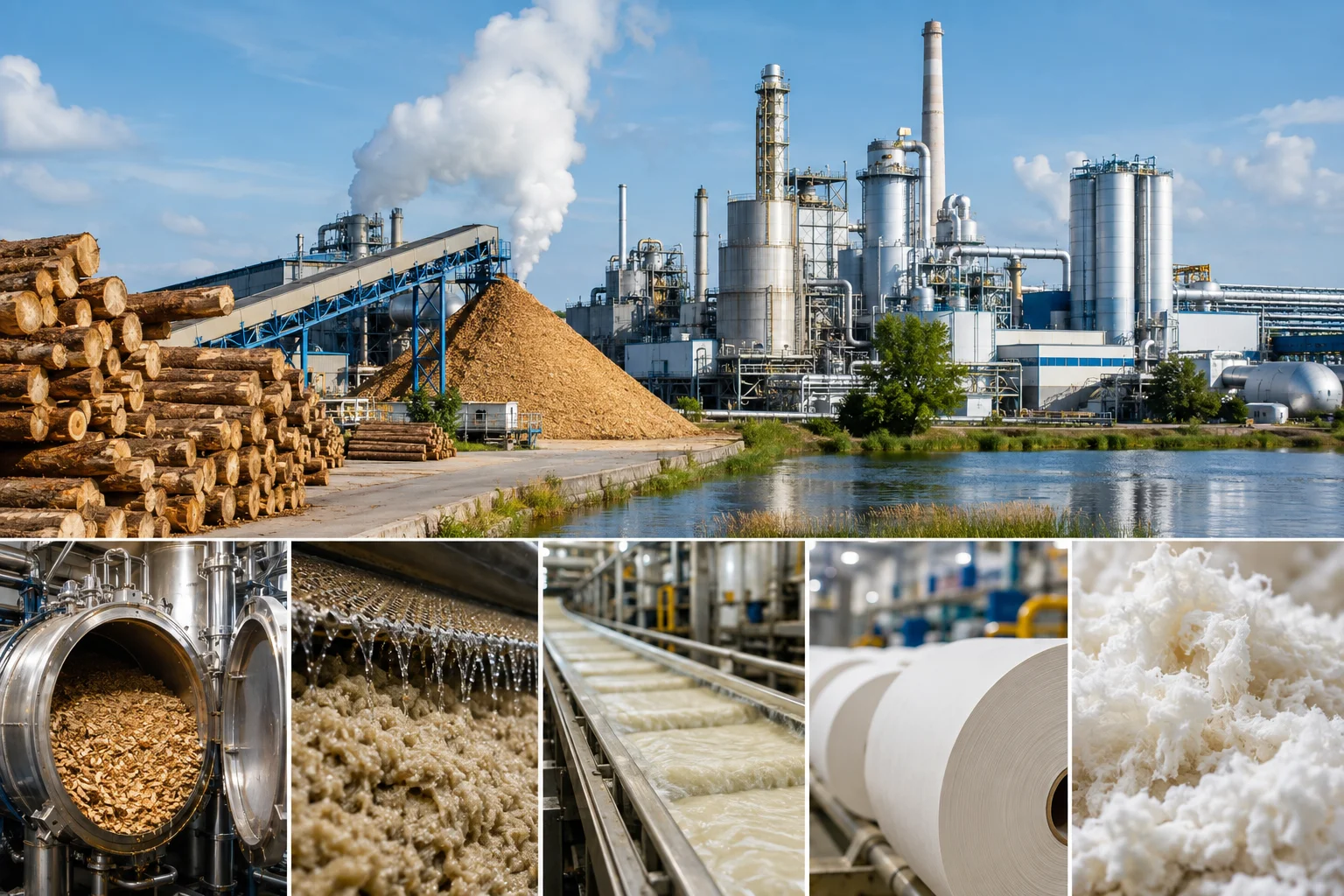
A modern pulp mill is a tightly integrated system where wood enters as raw timber and leaves as refined pulp ready for papermaking. Here's a breakdown of the core stages.
1. Wood Preparation
Logs arrive at the mill and go through debarking, where bark is mechanically stripped away. The debarked logs are then chipped into small, uniform pieces. Chip size matters a great deal here — chips that are too thick cook unevenly, while chips that are too thin can be wasted as fines during processing.
2. Cooking (Digestion)
This is the heart of the chemical pulping process. Wood chips are loaded into a digester along with a cooking liquor containing active chemicals. Under high temperature and pressure, the lignin binding the fibers dissolves, releasing individual cellulose fibers.
Digesters can operate as batch systems, where a fixed quantity of chips is cooked at a time, or as continuous systems, where chips flow steadily through the vessel. Continuous digesters are increasingly favored in modern pulp mill processing technology because they offer better energy efficiency and more consistent pulp quality.
3. Washing and Screening
Once cooked, the pulp is washed to remove residual cooking chemicals and dissolved organic material, collectively known as black liquor. Screening then removes uncooked knots, shives, and other debris, leaving behind clean, usable fiber.
4. Bleaching (Optional)
For applications requiring bright white paper, pulp goes through a bleaching sequence. Modern mills favor elemental chlorine-free (ECF) or totally chlorine-free (TCF) bleaching methods to reduce environmental impact while still achieving high brightness levels.
5. Chemical Recovery
One of the defining features of a well-run chemical pulping operation is chemical recovery. The black liquor collected during washing is concentrated and burned in a recovery boiler, generating steam for energy while recovering inorganic chemicals for reuse in the cooking process. This recovery loop is what makes large-scale chemical pulping both economically and environmentally sustainable.
How Kraft Pulping Works in Modern Pulp Mills
Among all chemical pulping methods, Kraft pulping stands out as the dominant global technology, and for good reason.
Quick answer: Kraft pulping uses a cooking liquor of sodium hydroxide and sodium sulfide to dissolve lignin in wood chips, producing strong, durable pulp with a highly efficient chemical recovery system.
Here's how the Kraft process unfolds step by step:
- Chip Charging – Prepared wood chips are fed into the digester along with white liquor, the active cooking chemical mixture.
- Cooking – The digester heats the mixture to temperatures typically between 150–180°C under pressure, breaking down lignin over one to several hours depending on the wood type and desired pulp properties.
- Blow Tank Discharge – Cooked pulp is discharged into a blow tank, where pressure release helps further separate the fibers.
- Washing – The pulp is washed in stages to separate fiber from the spent cooking liquor, now called black liquor.
- Recovery Cycle – Black liquor is sent to the recovery boiler and causticizing plant, where chemicals are regenerated into fresh white liquor, closing the loop.
This is precisely what makes how Kraft pulping works in modern pulp mills such a frequently asked question — the chemical recovery cycle is what sets Kraft apart from older, less sustainable pulping methods like the sulfite process. Kraft pulp is also known for producing exceptionally strong fibers, which is why it's the preferred choice for products like corrugated packaging, kraft paper bags, and high-strength printing papers.
Complete Chemical Pulping Process for Paper Manufacturing
To summarize the complete chemical pulping process for paper manufacturing, here is the typical flow from forest to finished pulp:
- Log receiving and debarking
- Chipping and chip screening
- Cooking in a digester with chemical liquor
- Blow tank discharge and initial fiber separation
- Washing to remove spent chemicals
- Screening to remove impurities and unwanted material
- Bleaching (if bright pulp is required)
- Chemical recovery through evaporation, combustion, and causticizing
- Pulp drying or direct transfer to a paper machine
Each stage is monitored closely, with modern mills using automated sensors and control systems to track temperature, pressure, chemical concentration, and pulp consistency in real time.
Chemical Pulping Equipment and Process Optimization Guide
A well-optimized pulp mill relies on several critical equipment systems working together seamlessly. Here's a practical chemical pulping equipment and process optimization guide covering the major components:
- Debarking Drums – Remove bark efficiently while minimizing wood loss
- Chippers – Produce uniform chip sizes for consistent cooking
- Digesters – The central cooking vessel, either batch or continuous
- Blow Tanks – Manage pressure release and initial fiber separation
- Brown Stock Washers – Separate pulp from black liquor efficiently
- Recovery Boilers – Burn black liquor to recover chemicals and generate energy
- Evaporators – Concentrate black liquor before combustion
- Causticizing Plant – Regenerate white liquor from recovered chemicals
- Bleach Plant Towers – Handle multi-stage bleaching reactions
Optimization in a modern mill focuses on a few key areas:
- Energy Efficiency: Recovery boilers and evaporators are optimized to maximize steam generation, often making mills largely self-sufficient in energy.
- Chemical Balance: Precise control of cooking chemical concentration reduces waste and improves pulp yield.
- Automation and Sensors: Real-time monitoring of digester temperature and liquor-to-wood ratios helps maintain consistent pulp quality while reducing downtime.
- Environmental Controls: Emission scrubbers and closed-loop chemical recovery systems minimize the environmental footprint of the operation.
Mills that invest in process optimization typically see improvements in yield, reduced chemical consumption, and lower energy costs — all of which directly affect the profitability of large-scale pulp production.
Frequently Asked Questions
What is the main difference between chemical and mechanical pulping?
Chemical pulping dissolves lignin using chemical reagents, producing stronger fibers, while mechanical pulping physically grinds wood, yielding higher output but weaker, less pure pulp.
Why is Kraft pulping the most widely used chemical pulping method?
Kraft pulping offers superior fiber strength, works with a wide range of wood species, and includes an efficient chemical recovery cycle that makes it more economical and sustainable than alternatives like sulfite pulping.
What equipment is essential in a chemical pulping line?
Core equipment includes debarking drums, chippers, digesters, blow tanks, washers, recovery boilers, evaporators, and bleach plant towers.
How does chemical recovery improve pulp mill sustainability?
Chemical recovery burns spent cooking liquor to regenerate reusable chemicals and generate steam energy, significantly cutting raw material costs and reducing waste output.
Is chemical pulping used for all types of paper?
Chemical pulping, especially Kraft pulping, is used for products needing strength and durability, such as packaging, kraft paper, and many printing and writing papers, while mechanical or combined methods may serve other applications like newsprint.
Final Thoughts
Chemical pulping technology continues to evolve, but its core principle — breaking down lignin to free strong, usable fibers — remains unchanged. From the digester to the recovery boiler, every stage of a modern pulp mill is designed to balance fiber quality, energy efficiency, and environmental responsibility.
Understanding how Kraft pulping works in modern pulp mills and the equipment behind it isn't just useful for engineers and mill operators. It offers a window into one of the most essential, yet often overlooked, industrial processes that keeps the global paper and packaging supply chain running.
 Our Services
 Media Pack Download
 Newsletters
 Industrial Events