Pulp and Paper Waste Recycling: Technologies, Processes and Resource Recovery
The pulp and paper industry sits at an odd crossroads. It is one of the largest industrial consumers of water, fiber, and energy, yet it also produces some of the most recoverable waste streams in manufacturing. Sludge, rejects, bark, ash, and de-inking residues once went straight to landfill. Today, pulp and paper waste recycling has become a core part of how mills stay profitable and compliant, turning what used to be a disposal cost into a source of recovered fiber, energy, and raw material for other industries.
This article breaks down how the process actually works, which technologies mills are adopting, and what "resource recovery" really means on the ground - not just in sustainability reports.
Why Paper Waste Recycling Matters Now
Every ton of pulp produced generates a meaningful volume of by-product waste - typically somewhere between 40 and 50% of the original wood input becomes non-product material at various stages. That includes bark from debarking, rejects from screening, sludge from wastewater treatment, and fly ash from biomass boilers.
Three pressures are pushing mills to treat this waste differently:
- Regulatory tightening. Landfill restrictions and extended producer responsibility rules in the EU, US, and parts of Asia are making disposal more expensive.
- Fiber scarcity. Virgin pulpwood costs and availability have made waste paper recovery economically attractive rather than optional.
- Circular economy mandates. Packaging and printing companies now demand recycled content certification from their paper suppliers, which pushes recycling requirements upstream to the mill itself.
The result is that paper mill recycling is no longer a side project handled by an environmental compliance team. It's increasingly integrated into core production planning.
How Pulp and Paper Mill Waste Is Recycled: The Core Process
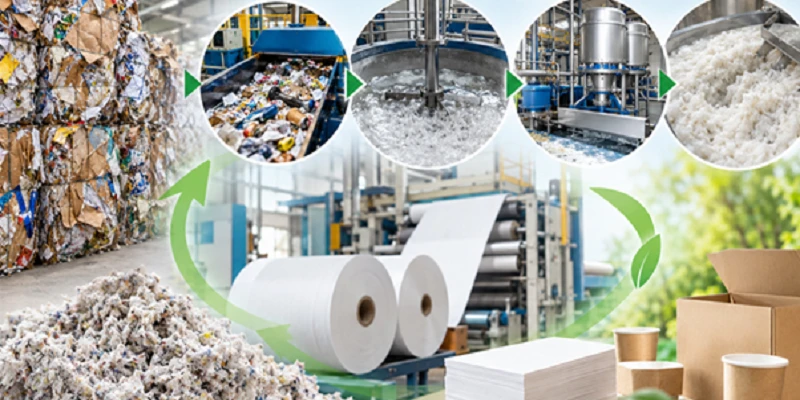
So how is pulp and paper mill waste actually recycled? The process generally moves through five stages, whether the input is post-consumer waste paper or internal mill by-products.
1. Collection and Sorting
Waste paper arrives at the mill baled, mixed with contaminants - plastics, staples, adhesive labels, food residue. Internal mill waste (rejects, trimmings, broke) is cleaner but still needs separation from fillers and coatings. Optical sorters, magnetic separators, and manual quality checks remove non-fiber material before pulping begins.
2. Repulping (Hydrapulping)
Sorted material goes into a hydrapulper, a large vat with a rotating blade that mixes waste paper with water to break it back down into a fiber slurry. This is the actual paper recycling process at its mechanical core - separating fiber from ink, coatings, and adhesives through agitation rather than chemical digestion.
3. Screening and Cleaning
The pulp slurry passes through screens and centrifugal cleaners that remove plastic film, staples, and heavier contaminants. Fine screening removes smaller particles that would otherwise show up as specks in the finished sheet.
4. De-inking
For paper destined for printing or writing grades, de-inking is essential. Flotation de-inking uses air bubbles and surfactants to lift ink particles to the surface, where they're skimmed off as froth. Washing de-inking, by contrast, rinses ink out with water - better suited for tissue-grade recycled pulp.
5. Refining and Reuse
The cleaned fiber is refined to restore some of its bonding strength (recycled fibers shorten and weaken slightly with each cycle) before being blended with virgin pulp as needed and sent to the paper machine.
Recycling Technologies for Paper Mills
The stages above haven't changed conceptually in decades, but the equipment behind them has advanced considerably. Some of the recycling technologies for paper mills driving efficiency gains today include:
- Enzymatic de-inking, which uses cellulase and other enzymes to loosen ink from fiber with less chemical load than traditional flotation methods.
- Membrane filtration systems for closing water loops, reducing both fresh water intake and effluent volume.
- Anaerobic digestion of sludge, converting organic residue from wastewater treatment into biogas that can offset natural gas use in the mill's boiler.
- Fluidized bed combustion for burning sludge and rejects that can't be recovered as fiber, generating process steam while reducing landfill volume.
- AI-assisted contaminant sorting, using near-infrared and machine vision systems to flag non-recyclable material before it reaches the pulper, cutting downtime from clogs and jams.
- Fiber fractionation technology, which separates long and short fibers from recovered pulp so each can be routed to the grade of paper where it performs best, rather than blended indiscriminately.
Mills that combine several of these technologies typically see reject rates fall and recovered fiber yield rise - a combination that pays for the capital investment over a few years rather than a decade.
Pulp Mill Waste Recycling: Beyond the Fiber Stream
Pulp mill waste recycling covers more than fiber recovery. Kraft pulp mills, in particular, generate several by-product streams worth capturing:
- Black liquor recovery, where the lignin and chemicals separated during kraft pulping are burned in a recovery boiler to regenerate cooking chemicals and generate energy - this is arguably the oldest and most successful industrial recycling loop in the sector.
- Lime mud recycling, where calcium carbonate by-product is calcined and reused in the causticizing cycle instead of purchasing fresh lime.
- Bark and wood residue, chipped and burned as biomass fuel or, increasingly, processed into biochar or garden mulch products.
- Fly ash and boiler ash, which can be repurposed in cement production or as a soil amendment when heavy metal content is low enough.
These recovery loops are why integrated pulp and paper mills often report far lower net waste-to-landfill ratios than standalone paper mills that buy in market pulp.
Waste Recovery Solutions for Paper Manufacturing
Not every mill has the capital for large-scale reprocessing infrastructure. That's driven demand for modular and outsourced waste recovery solutions for paper manufacturing, including:
- Third-party sludge-to-energy contracts, where a specialist operator collects mill sludge and processes it off-site into fuel pellets or biogas.
- Rented or leased de-inking units for smaller mills that recycle intermittently rather than as a continuous production line.
- Packaging partnerships, where reject fiber too short for paper-grade use is sold to molded pulp packaging manufacturers (egg cartons, protective packaging) instead of being landfilled.
- Construction material co-processing, where paper sludge ash is blended into cement clinker or lightweight aggregate.
These solutions matter most for mid-sized mills that generate real waste volumes but not enough to justify building dedicated recovery plants in-house.
Sustainable Paper Mill Waste Recycling Technologies: What's Changing
Looking ahead, a few trends are shaping sustainable paper mill waste recycling technologies:
Closed-loop water systems are becoming close to standard in new mill builds, cutting fresh water withdrawal by up to 90% compared to open systems from a generation ago.
Carbon accounting integration means recovery technology choices are increasingly evaluated not just on cost, but on their contribution to a mill's carbon footprint - biogas from sludge digestion, for instance, displaces fossil natural gas and counts toward emissions targets.
Chemical recovery efficiency continues to improve through better recovery boiler design, pushing chemical loss rates down and reducing the need for fresh caustic soda or lime purchases.
Digital twins and predictive maintenance are being applied to recovery boilers and de-inking lines to reduce unplanned downtime, which indirectly improves recycling throughput by keeping recovery equipment running closer to full capacity.
Frequently Asked Questions
What percentage of paper can realistically be recycled?
Most paper fiber can go through five to seven recycling cycles before the fibers become too short and weak to bond properly into new sheets. After that point, the fiber is typically diverted to lower-grade products like molded packaging or used as fuel.
What is the difference between paper waste recycling and pulp mill waste recycling?
Paper waste recycling generally refers to processing recovered paper (post-consumer or post-industrial) back into usable fiber. Pulp mill waste recycling is broader - it includes fiber recovery but also covers chemical recovery, energy generation from black liquor and bark, and reuse of by-products like lime mud and ash.
Is de-inked recycled pulp as strong as virgin pulp?
No - recycled fiber loses some strength with each cycle due to shortening and reduced bonding capacity. Mills typically blend recycled and virgin fiber to hit target strength specifications, rather than using 100% recycled pulp for structural grades.
What happens to the sludge generated during paper recycling?
Sludge from de-inking and wastewater treatment is commonly dewatered and then either incinerated for energy recovery, sent to anaerobic digestion for biogas, or processed into materials for construction and agriculture, depending on its composition and local regulations.
Can all types of waste paper be recycled together?
Not efficiently. Mills typically sort waste paper by grade - old corrugated containers, mixed office paper, newsprint, and coated stock - because contamination and fiber quality vary significantly between grades, and mixing them lowers the quality of the recovered pulp.
The Bottom Line
Modern pulp and paper waste recycling isn't a single process - it's a network of interconnected recovery systems covering fiber, chemicals, water, and energy. Mills that treat these streams as resources rather than waste tend to see measurable gains: lower raw material costs, reduced disposal fees, and stronger compliance positioning as environmental regulations tighten. As recycling technologies for paper mills continue to mature - from enzymatic de-inking to AI-driven sorting - the gap between "waste management" and "resource recovery" in this industry keeps narrowing, and the mills that adapt fastest are the ones best positioned to stay competitive.
 Our Services
 Media Pack Download
 Newsletters
 Industrial Events