Optimizing Flow Control in Pulp and Paper Mills Through Smart Maintenance and Digital Monitoring
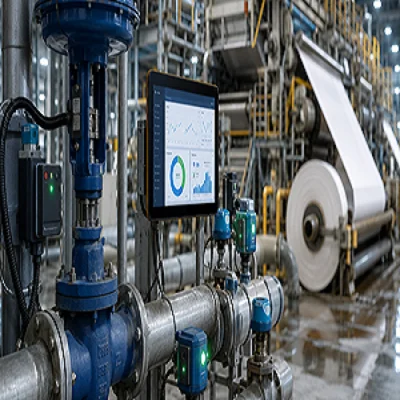
Walk through any pulp and paper mill and you'll notice something quickly: almost everything depends on fluid moving correctly from one stage to the next. Stock, white water, chemicals, steam — all of it has to flow at the right pressure, the right rate, and the right time. When flow control slips even slightly, the ripple effects show up in sheet quality, energy costs, and unplanned downtime.
For decades, mills managed this with scheduled maintenance and manual checks. That approach worked well enough when margins were forgiving and downtime was cheaper. Today, it isn't enough. Rising energy costs, tighter quality tolerances, and aging infrastructure are pushing mills toward a smarter model — one built on predictive maintenance, real-time flow monitoring, and connected industrial sensors. This shift isn't just a technology upgrade; it's a fundamental change in how mills think about reliability.
Why Flow Control Is the Backbone of Mill Performance
Flow control touches nearly every stage of papermaking — from the pulping and bleaching stages through stock preparation, the headbox, and the wet end. Valves, pumps, and actuators regulate consistency, chemical dosing, and water balance. A valve that sticks, drifts, or fails silently doesn't just cause a local problem. It can throw off basis weight, moisture content, or fiber distribution across the entire sheet.
The challenge is that many of these failures don't announce themselves. A valve can appear to be functioning normally on the surface while internally it's degrading — seat wear, actuator lag, or cavitation building up over weeks. By the time an operator notices a quality deviation, the underlying mechanical issue may have existed for a while. This is exactly the gap that condition monitoring and digital monitoring solutions for flow control equipment are designed to close.
From Reactive to Predictive: A Necessary Shift
Traditional maintenance in pulp and paper mills has largely followed two models: reactive (fix it when it breaks) and preventive (fix it on a fixed schedule, whether it needs it or not). Both have real limitations.
Reactive maintenance is expensive because it almost always coincides with unplanned downtime, and in a continuous process environment, downtime is costly in both product loss and restart time. Preventive maintenance is safer but inefficient — it often means replacing parts that still have useful life left, or missing failures that develop faster than the schedule anticipated.
Predictive maintenance systems change this equation. Instead of guessing when a component might fail, mills use continuous data — vibration, temperature, acoustic signatures, pressure differentials — to understand the actual condition of equipment in real time. Maintenance is then scheduled based on need, not on a calendar. For pulp and paper operations, where flow-critical assets like control valves, pumps, and actuators run around the clock, this shift alone can meaningfully reduce both maintenance costs and unplanned stoppages.
The Role of Industrial Sensors in Modern Mills
None of this works without accurate, continuous data, and that's where industrial sensors come in. Modern mills are increasingly instrumenting flow-critical equipment with sensors that track:
- Vibration and acoustic emissions on pumps and valve actuators
- Temperature variance across bearings, seals, and motor housings
- Pressure drop and flow rate deviations across control valves
- Position feedback and response time on automated valves
These sensors don't just collect data for its own sake. When integrated with analytics platforms, they establish a baseline "healthy" signature for each asset. Deviations from that baseline — even small ones — become early warning signs long before a failure would be visible through manual inspection. This is particularly valuable in pulp and paper environments, where equipment often operates in harsh conditions involving abrasive stock, corrosive chemicals, and high humidity that accelerate wear.
Flow Monitoring: Seeing the Process, Not Just the Equipment
Condition monitoring tells you about the health of a specific asset. Flow monitoring tells you about the health of the process itself. Together, they give a much fuller picture.
Real-time flow monitoring tracks how fluid is actually moving through the system — flow rate, consistency, pressure, and temperature at key points along stock and chemical lines. When flow monitoring is paired with condition monitoring data, mills can start correlating process deviations with specific equipment behavior. For example, a gradual drop in flow rate through a particular valve, combined with rising actuator response time, is a strong indicator of internal wear well before the valve fails outright.
This combination is especially powerful for identifying issues that wouldn't be obvious from either data stream alone. A valve might show normal vibration readings but abnormal flow characteristics, or vice versa. Only by monitoring both together do mills get a reliable early-warning system for process disruption.
Valve Condition Monitoring: A Focused Priority
Among all flow control equipment, valves deserve particular attention. Pulp and paper mills often run thousands of valves across stock preparation, bleaching, chemical dosing, and steam systems, and many of these operate in demanding conditions — abrasive slurries, corrosive bleach chemicals, and cyclical pressure loads.
Valve condition monitoring focuses specifically on tracking indicators like seat leakage, actuator torque, stem friction, and response lag. These metrics reveal wear patterns long before a valve fails to open, close, or hold position correctly. For predictive maintenance for industrial valves in paper mills, this kind of targeted monitoring is often where mills see the fastest return — valves are numerous, relatively low-cost individually, but collectively responsible for a large share of flow-related quality issues and unplanned stops.
Some mills prioritize valve monitoring on critical control loops first — headbox consistency valves, bleach plant dosing valves, and steam control valves — since these have the most direct impact on product quality and safety. From there, monitoring can expand to less critical assets as the program matures.
Building an Industrial Asset Management Strategy Around Data
Sensors and monitoring tools generate data, but the real value comes from how that data is organized and acted upon. This is where industrial asset management platforms come in. Rather than treating each sensor reading as an isolated alert, these platforms consolidate data across the mill — valves, pumps, motors, and instrumentation — into a single view of asset health.
A mature asset management approach typically includes:
- Centralized dashboards that rank assets by risk or urgency, not just by alarm status
- Historical trending to distinguish gradual wear from sudden anomalies
- Integration with maintenance management systems so alerts translate directly into work orders
- Reporting that ties equipment condition back to production KPIs like uptime and quality yield
When asset management is done well, maintenance teams stop chasing alarms reactively and start prioritizing work based on actual risk to production. That shift in mindset — from equipment-by-equipment firefighting to mill-wide risk management — is often what separates mills that get real value from digital monitoring from those that just accumulate unused data.
Improving Paper Mill Reliability Through Smart Maintenance
The end goal of all this — sensors, monitoring, predictive systems, asset management — is reliability. Improving paper mill reliability through smart maintenance isn't about adopting technology for its own sake. It's about reducing the frequency and severity of unplanned events that disrupt production, damage equipment, or compromise product quality.
Mills that have moved toward predictive and condition-based maintenance strategies typically report a few consistent benefits:
- Fewer unplanned shutdowns tied to flow control equipment failures
- Longer equipment life due to timely, targeted interventions rather than either neglect or over-maintenance
- More stable process conditions, which translates into more consistent sheet quality
- Better allocation of maintenance labor, focused on assets that actually need attention
None of this happens overnight. Mills that succeed with digital monitoring tend to start with a focused pilot — often on a handful of critical valves or pumps — before scaling the approach mill-wide. This lets teams validate sensor accuracy, tune alert thresholds, and build trust in the data before expanding coverage.
Common Questions About Predictive Maintenance for Flow Control
What is predictive maintenance in the context of pulp and paper mills?
It's a maintenance strategy that uses real-time sensor data — vibration, temperature, pressure, and flow readings — to detect early signs of equipment wear or failure, allowing maintenance teams to intervene before a breakdown occurs rather than on a fixed schedule.
Why is valve condition monitoring important in paper mills?
Valves regulate consistency, chemical dosing, and steam flow throughout the mill. Because they operate constantly in abrasive and corrosive conditions, undetected wear can quickly affect product quality and lead to unplanned downtime. Monitoring valve-specific indicators like seat leakage and actuator response catches problems early.
How does flow monitoring differ from condition monitoring?
Condition monitoring tracks the health of individual equipment components. Flow monitoring tracks the behavior of the process itself — flow rate, pressure, and consistency. Used together, they give a more complete picture of both equipment health and process stability.
What role do industrial sensors play in predictive maintenance systems?
Sensors are the data source that makes predictive maintenance possible. They continuously capture vibration, temperature, pressure, and position data, which analytics platforms use to detect deviations from normal operating patterns.
How can mills start implementing digital monitoring for flow control equipment?
Most successful implementations start small — instrumenting a limited set of critical valves or pumps, validating the data, and expanding coverage gradually as the maintenance team builds confidence in the system and integrates it with existing asset management workflows.
Looking Ahead
Flow control will always be central to how pulp and paper mills operate, but the way mills manage it is changing. The combination of industrial sensors, condition and flow monitoring, and predictive maintenance systems is giving maintenance teams visibility they've never had before — not just into whether equipment is running, but into how well it's running and how long it's likely to keep doing so.
For mills weighing where to start, valve condition monitoring is often the most practical entry point, given how many valves are in service and how directly they affect quality and flow stability. From there, building out a broader industrial asset management strategy turns scattered sensor data into a genuine reliability program — one that keeps the mill running steadier, with fewer surprises, and at a lower long-term cost.
 Our Services
 Media Pack Download
 Newsletters
 Industrial Events