Valve Automation Technologies Improving Paper Mill Efficiency
Introduction:
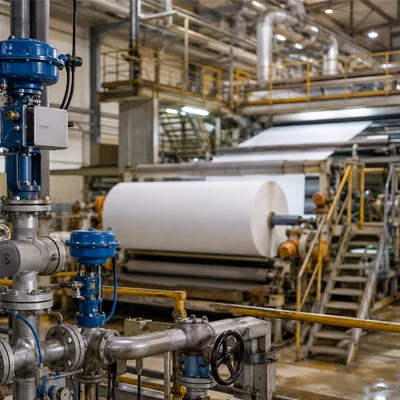
Paper manufacturing is one of the most process-intensive industries in the world, relying on a continuous, tightly choreographed flow of water, steam, chemicals, and pulp slurry through hundreds of interconnected pipelines. At the heart of this complex network sit valves — the unassuming components that regulate pressure, direct flow, and maintain the delicate balance required for consistent paper quality. As paper mills face mounting pressure to reduce operating costs, minimize downtime, and meet stricter environmental standards, valve automation has emerged as one of the most impactful investments a mill can make. By replacing manual, labor-intensive valve operations with intelligent, connected systems, paper producers are unlocking new levels of efficiency, safety, and profitability.
The Role of Valves in Paper Mill Operations
Every stage of papermaking — from wood chip cooking and pulp bleaching to stock preparation, sheet forming, and drying — depends on precise fluid control. Steam pressure must be regulated for drying cylinders. Chemical dosing must be accurate to avoid off-spec pulp. Water flow must be balanced to prevent sheet breaks. Traditionally, these tasks were managed through manually operated valves, requiring operators to physically walk the plant floor, read gauges, and adjust settings by hand. This approach, while functional for decades, is inherently slow, inconsistent, and prone to human error.
As mills scale up production and diversify their product lines, the limitations of manual valve control become a serious bottleneck. This is where control valves enhanced with automation technology step in, transforming reactive, manual adjustments into proactive, data-driven process management.
What Is Valve Automation?
Valve automation refers to the integration of actuators, sensors, controllers, and communication technology into valve assemblies so they can be operated remotely, automatically, or semi-automatically based on real-time process data. Instead of an operator manually turning a handwheel, an automated system receives a signal — from a programmable logic controller (PLC), distributed control system (DCS), or a cloud-based monitoring platform — and adjusts the valve position instantly and precisely.
This shift from manual to automated operation touches nearly every part of the paper production process, including pulping, bleaching, chemical recovery, stock preparation, and the paper machine itself. The result is a plant that can respond to changing conditions in milliseconds rather than minutes, dramatically improving both efficiency and product consistency.
Actuated Valves: The Foundation of Automation
Actuated valves are the physical backbone of any valve automation strategy. An actuator is a mechanical device — pneumatic, electric, or hydraulic — that converts a control signal into physical movement, opening, closing, or modulating the valve without human intervention.
In paper mills, actuated valves are used extensively in:
- Steam distribution systems, where precise modulation prevents pressure spikes that can damage drying cylinders or scorch paper webs.
- Chemical dosing lines, where actuators ensure bleaching agents, retention aids, and sizing chemicals are added in exact proportions.
- Stock preparation, where consistency of pulp density directly affects sheet quality.
Effluent and water treatment systems, where automated shutoff and diversion valves help mills comply with environmental discharge regulations.
By eliminating the delay and variability associated with manual adjustment, actuated valves allow paper mills to maintain tighter process tolerances, reduce material waste, and protect expensive equipment from damage caused by pressure or flow irregularities.
Smart Valves and Intelligent Valve Systems
While actuation provides the muscle for automation, smart valves provide the intelligence. Smart valves are equipped with embedded sensors, microprocessors, and diagnostic capabilities that allow them to do far more than simply open and close. They can measure flow rate, temperature, pressure, and valve position in real time, and communicate this data back to plant control systems using industrial communication protocols such as HART, Foundation Fieldbus, or industrial Ethernet.
This is where smart valve technologies for paper manufacturing deliver some of their most significant value. Rather than functioning as isolated mechanical devices, smart valves become active participants in the plant's broader data ecosystem. Combined into networks, they form intelligent valve systems capable of self-diagnosis, predictive maintenance alerts, and adaptive control based on evolving process conditions.
For example, an intelligent valve system managing the bleaching stage of pulp processing can automatically detect a change in pulp consistency and adjust chemical dosing valves accordingly, without waiting for an operator to notice and manually intervene. This level of responsiveness is simply not achievable with conventional mechanical valves.
Automated Flow Control: Precision at Every Stage
Automated flow control is the operational outcome of combining actuated and smart valve technologies with a centralized control architecture. Rather than treating each valve as an independent point of adjustment, automated flow control systems coordinate multiple valves across a process line to maintain optimal flow rates, pressures, and chemical concentrations simultaneously.
In pulp and paper operations, this coordination is essential. A single disruption — such as a sudden change in pulp density entering the headbox — can cascade through the entire paper machine, causing sheet breaks, quality defects, or costly downtime. Automated flow control systems in pulp mills are designed to detect these disruptions early and make micro-adjustments across dozens of valves in real time, preventing minor fluctuations from becoming major production problems.
Beyond quality control, automated flow control also plays a critical role in energy management. Steam and water are among the largest operating costs in a paper mill. By precisely matching flow rates to actual process demand rather than relying on conservative manual settings, mills can significantly reduce energy and water consumption, translating directly into cost savings and a smaller environmental footprint.
Digital Valve Monitoring: Turning Data into Decisions
Perhaps the most transformative element of modern valve automation is digital valve monitoring. This technology continuously tracks the health and performance of every automated valve in the plant, capturing data such as actuator travel, response time, seat leakage, and cycle counts.
Historically, valve maintenance in paper mills followed a reactive or, at best, calendar-based schedule — valves were inspected or serviced at fixed intervals regardless of their actual condition. This approach often led to two costly outcomes: either valves failed unexpectedly between scheduled inspections, causing unplanned downtime, or perfectly functional valves were serviced unnecessarily, wasting labor and materials.
Digital valve monitoring eliminates this guesswork. By continuously analyzing valve performance data, plant engineers can identify early signs of wear, actuator degradation, or seal failure long before they result in a process upset. This shift toward condition-based, predictive maintenance is one of the clearest examples of how intelligent valve monitoring for industrial plants delivers measurable return on investment — not just in reduced downtime, but in extended equipment life and improved worker safety, since fewer emergency repairs mean fewer technicians working under pressure on live systems.
Many digital valve monitoring platforms also integrate with plant-wide asset management software, giving maintenance teams a unified dashboard to prioritize repairs across the entire facility, not just the paper machine area. This holistic visibility helps mills allocate maintenance resources more efficiently and plan shutdowns around genuine need rather than fixed schedules.
Business Benefits beyond the Process Floor
The advantages of valve automation extend well beyond the immediate process improvements. Mills that have adopted comprehensive automation strategies typically report:
- Reduced unplanned downtime, thanks to predictive maintenance enabled by digital monitoring.
- Lower energy and water costs, resulting from precise, demand-matched flow control.
- Improved product consistency, which reduces off-spec production and material waste.
- Enhanced worker safety, since automated systems reduce the need for manual intervention in hazardous or high-temperature areas.
- Stronger regulatory compliance, particularly around effluent discharge and emissions, where automated valves can respond instantly to maintain limits.
Better data for continuous improvement, as historical valve performance data feeds into broader plant optimization initiatives.
These benefits compound over time. A mill that begins with automation in one critical area, such as chemical dosing or steam control, often finds a clear business case to expand automation across additional process lines, gradually building a fully connected, intelligently managed facility.
Challenges and Considerations for Implementation
Despite the clear advantages, valve automation is not without its challenges. Initial capital investment can be significant, particularly for older mills with legacy infrastructure that requires retrofitting. Integration with existing control systems demands careful planning, and staff need training to interpret and act on the new streams of data generated by smart valves and monitoring platforms.
Mills considering automation upgrades typically benefit from a phased approach: starting with the highest-impact, highest-risk process areas — such as steam and chemical control — before expanding to less critical systems. Partnering with experienced automation vendors who understand the specific demands of pulp and paper processing, including exposure to corrosive chemicals and high-consistency slurries, is also essential to selecting valve and actuator materials that will perform reliably over the long term.
Conclusion
Valve automation has moved from a competitive advantage to a near-necessity for paper mills seeking to remain efficient, safe, and profitable in an increasingly demanding market. Through the combined power of actuated valves, smart valve technologies, automated flow control, and digital valve monitoring, mills can achieve a level of process precision and reliability that manual operations simply cannot match. As pulp and paper producers continue to face rising energy costs, tightening environmental regulations, and growing pressure to maximize output quality, investment in intelligent valve systems offers a clear path toward a more resilient, data-driven, and efficient future for the industry.
 Our Services
 Media Pack Download
 Newsletters
 Industrial Events