Paper Types and Quality from Chemical Pulping Processes
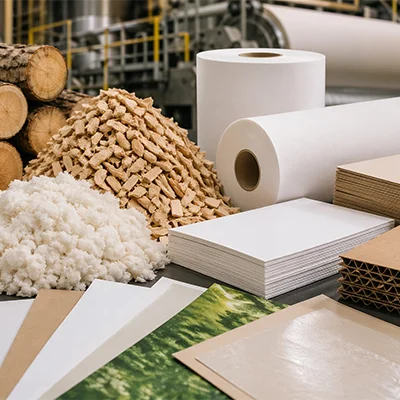
Most people will refer you to thickness, smoothness, or brightness, as the determinants of paper quality. However, within a paper mill the actual solution lies in the process, long beforehand. It starts at pulping.
More specifically, it starts with how the fibers are treated before they ever become paper.
That’s where chemical pulping paper makes a difference. Chemical pulping doesn’t just convert raw material into usable form by dissolving lignin and isolating the usable cellulose fibers, but by doing so what type of paper to produce, without a murmur.
And that is what is taken into all things: strength, finish, durability and finally, the variety of types of paper that a manufacturer can provide.
What Is the Difference between Chemical Pulping?
On a simplistic level, chemical pulping separates fibers based on chemical reactions rather than mechanical force. But practically, that is a bigger effect than that.
When lignin is removed:
- Fibers become softer and more flexible
- Bonding improves significantly
- The resulting sheet becomes stronger and more uniform
That is why paper produced by chemical processes is the pulp paper that is commonly used in any application where performance is more important than cost.
An example is the kraft process that is known to produce tough fibers that are used in packaging. Sulfite pulping on the other hand is biased towards a smoother and lighter productions. Neither is “better”—they just serve different end uses.
Paper Types from Chemical Pulping
One of the biggest advantages of chemical pulping is flexibility. It doesn’t lock manufacturers into a single product category. Instead, it supports a wide mix of paper types from chemical pulping, depending on how the fibers are processed afterward.
Printing and Writing Papers
This is probably the most familiar category. Office sheets, textbooks, notebooks—all of these depend on fiber consistency more than raw strength.
Chemically treated pulp helps here by giving:
- Even sheet formation
- Controlled ink absorption
- Cleaner, brighter surfaces
That’s why high-quality printing grades almost always rely on chemical pulping.
Packaging Grades
Now shift to packaging, and the priorities change completely.
Here, the focus is strength. Not just basic strength, but resistance to tearing, folding, and handling stress.
Kraft-based chemical pulping paper is widely used for:
- Corrugated boxes
- Industrial sacks
- Carton boards
These fall into industrial paper grades produced by chemical pulping methods, where durability is the main requirement.
Tissue and Hygiene Paper
This type is at the other extreme.
The emphasis is made on softness and absorbency rather than strength. And interestingly, those qualities also depend heavily on how fibers are processed during pulping.
Small adjustments in chemical treatment can change:
- Fiber thickness
- Surface feel
- Liquid absorption behavior
That’s why tissue products are more sensitive to pulping conditions than they appear.
Specialty Papers
Then there are papers that don’t fall into everyday categories.
Think of:
- Filter paper
- Electrical insulation sheets
- Food-grade wrapping paper
These paper grades are designed for specific functions. In many cases, the pulping stage is tightly controlled because even slight variation can affect performance.
Paper Grades: More Than Just Labels
In B2B markets, paper grades are not just classifications—they’re shorthand for performance expectations.
And most of those expectations tie back to pulping.
For example:
- Unbleached grades usually mean higher strength
- Fully bleached grades point to appearance and purity
- Semi-chemical grades indicate a balance between cost and durability
So when buyers specify a grade, they’re indirectly specifying how the pulp should behave.
How Chemical Pulping Affects Paper Type and Quality
This is where it gets more technical- but it is also more interesting.
You need to see what chemical pulping does to fibers in order to appreciate the impact of chemical pulping on paper type and quality.
Strength and Durability
Once lignin is removed, fibers can bond more tightly. That directly improves tensile strength and folding resistance.
This is why chemically pulped paper holds up better in packaging and industrial use.
Surface and Printability
Smoother fibers lead to better surface formation. That matters for printing, where uneven surfaces can affect ink distribution.
It also becomes important for coated applications.
Brightness and Cleanliness
Bleaching removes residual color and impurities. This isn’t just about looks—it also affects usability in food packaging and medical-grade paper.
Absorbency
Not all paper should absorb liquid in the same way.
- Printing paper needs controlled absorption
- Tissue needs high absorbency
Both are influenced during pulping and refining stages.
Paper GSM from Pulping Processes
GSM is often treated as a finishing parameter, but the base comes from fiber quality.
The nature of paper gsm from pulping processes depends on how well fibers bond and distribute.
Stronger fibers allow manufacturers to:
- Maintain structure at higher GSM
- Reduce material waste
- Achieve better consistency
Typical ranges look like this:
- Low GSM: tissue and lightweight sheets
- Medium GSM: printing and writing
- High GSM: packaging and boards
Consistency here is critical, especially for automated converting and printing lines.
Coated vs Uncoated Paper: Pulping where it Shows its Effect
Pulping of coated and uncoated paper has a slight yet significant effect with chemical pulping.
Uncoated Paper
For uncoated grades, the base sheet is everything.
There’s no layer to hide defects, so fiber quality directly affects:
- Texture
- Strength
- Ink behavior
Chemical pulping helps maintain uniformity across the sheet.
Coated Paper
With coated paper, things get more layered—literally.
The base sheet must support coatings without cracking or uneven absorption.
That requires:
- Strong internal bonding
- Smooth surface formation
- Dimensional stability
All of which start at the pulping stage.
Industrial Relevance
Across industries, the demand for reliable paper products continues to grow.
From e-commerce packaging to food-grade materials, industrial paper grades produced by chemical pulping methods are widely used because they offer predictable performance.
And in large-scale operations, predictability is just as important as quality.
A Note on Process Efficiency
Chemical pulping is known to be heavy resource-wise. It is not necessarily untrue--but that is also old-fashioned.
Modern mills are improving efficiency through:
- Chemical recovery systems
- Water reuse
- Energy optimization
It is therefore an intensive process and is becoming more sustainable without compromising chemical pulping and paper quality.
Final Thoughts
In many ways, the pulping stage doesn’t get the attention it deserves. It happens early, out of sight, and before the paper starts to look like a finished product.
But it’s also where the most important decisions are made.
Chemical pulping is flexible and hence the wide variety of paper types available. With the manipulation of the treatment of fibers, manufacturers can alternate between strength, softness, brightness, or absorbency.
It is that elasticity that makes chemical pulping still pertinent--even in the face of industry change.
And for anyone working in paper sourcing or production, understanding this link between process and outcome isn’t optional. It’s what separates a standard product from one that performs exactly as required.
 Our Services
 Media Pack Download
 Newsletters
 Industrial Events