Paper Recycling Process in Manufacturing: Stages, Systems, and Technologies
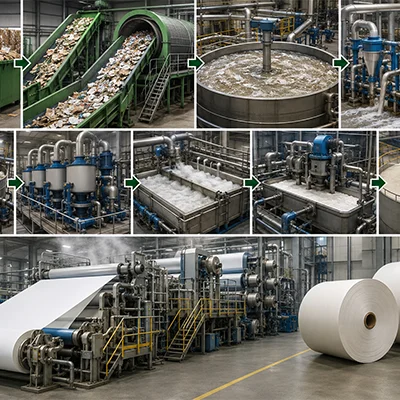
The paper recycling process has evolved far beyond collecting old newspapers and converting them into low-grade packaging materials. Modern recycling mills operate as highly automated manufacturing facilities where advanced sorting technologies, intelligent process controls, fiber recovery systems, and sustainable water management transform discarded paper into high-quality products suitable for packaging, printing, tissue, and specialty applications. As manufacturers face increasing pressure to reduce virgin fiber consumption, lower carbon emissions, and embrace circular production models, innovations in the paper recycling industry are redefining how recovered fibers are processed.
This article explores the industrial journey of waste paper recycling, examining each stage of the recycled paper manufacturing process, the technologies driving operational efficiency, and why recycling has become a strategic manufacturing advantage rather than simply an environmental initiative.
Paper Recycling Process in Manufacturing: Stages, Systems, and Technologies
For decades, paper recycling was viewed primarily as an environmental responsibility. Today, it has become a sophisticated manufacturing discipline where engineering precision, automation, material science, and sustainability converge to create high-quality paper products from recovered fibers.
Modern paper mills no longer see recovered paper as waste—they see it as a valuable raw material. Every bale of sorted office paper, corrugated packaging, magazines, cartons, and industrial scrap represents usable fiber waiting to re-enter production.
With global demand for sustainable packaging, e-commerce shipping materials, tissue products, and recycled printing grades continuing to grow, manufacturers are investing heavily in smarter recycling systems capable of producing cleaner pulp, improving fiber yield, reducing water consumption, and minimizing energy usage.
Understanding the paper recycling process therefore means understanding one of manufacturing's most important circular production systems.
Why Recycling Has Become a Manufacturing Strategy
Paper manufacturers today are balancing multiple business priorities simultaneously:
- Rising virgin pulp costs
- Corporate sustainability commitments
- Circular economy regulations
- Customer demand for recycled products
- Carbon reduction targets
- Resource conservation
Rather than relying exclusively on freshly harvested wood fibers, manufacturers increasingly blend recovered fibers into production.
For many mills, recycled paper is no longer an alternative raw material—it is becoming the primary one.
This shift has transformed the paper recycling industry into an advanced manufacturing ecosystem involving collection networks, material recovery facilities, automated sorting centers, recycling plants, and high-efficiency paper mills operating as an interconnected supply chain.
Stage 1: Collection and Recovery—The Beginning of the Manufacturing Journey
Every successful recycling operation starts long before paper reaches the mill.
The quality of finished paper depends significantly on the quality of incoming recovered material.
Sources typically include:
- Commercial offices
- Printing facilities
- Retail packaging
- Corrugated shipping boxes
- Distribution warehouses
- Residential recycling programs
- Industrial manufacturing waste
- Educational institutions
Unlike consumer perception, manufacturers rarely process mixed waste directly.
Instead, extensive sorting systems separate materials according to:
- Fiber quality
- Paper grade
- Coating type
- Ink coverage
- Moisture level
- Contamination percentage
This first phase of waste paper recycling determines downstream processing efficiency more than any other stage.
Higher-quality recovered paper reduces chemical consumption, improves fiber recovery, and minimizes production downtime.
Stage 2: Intelligent Sorting Systems
One of the most important waste paper processing steps occurs before pulping even begins.
Modern recycling facilities increasingly use automated technologies including:
- Optical scanners
- Near-infrared sensors
- AI-powered image recognition
- Robotic sorting arms
- Conveyor-based inspection systems
- Magnetic separators
- Air classification equipment
These systems identify unwanted materials such as:
- Plastic films
- Metal staples
- Food contamination
- Wax-coated paper
- Laminated packaging
- Adhesives
- Textiles
Advanced sorting improves raw material consistency while reducing contamination entering the pulping process.
The result is improved product quality and lower operational costs.
Stage 3: Pulping—Where Waste Paper Becomes Manufacturing Feedstock
One of the most recognizable stages in the recycled paper manufacturing process is pulping.
Inside large industrial pulpers, recovered paper is mixed with water and mechanical agitation.
Rather than simply shredding paper, pulpers separate individual cellulose fibers while preserving fiber integrity.
Depending on production requirements, mills may operate:
- Drum pulpers
- Continuous pulpers
- High-consistency pulpers
- Low-consistency pulpers
During this phase, contaminants begin separating naturally from usable fibers.
Large debris including plastics, strings, wires, and packaging materials are removed using coarse screening systems.
At this point, discarded paper no longer resembles waste.
It has become fiber slurry—the primary manufacturing material used throughout the remainder of production.
Stage 4: Screening and Cleaning Systems
Recovered fibers still contain numerous unwanted materials.
This stage focuses on removing contaminants without losing valuable fiber.
Equipment commonly includes:
- Pressure screens
- Centrifugal cleaners
- Fine slot screens
- Vibrating screens
- Hydrocyclones
These technologies separate contaminants based on:
- Density
- Size
- Shape
- Weight
- Fiber characteristics
Modern cleaning systems recover maximum usable fiber while reducing reject losses.
Digital monitoring also allows operators to continuously optimize screening efficiency based on incoming waste quality.
Stage 5: Deinking—Creating High-Quality Recycled Fibers
One of the biggest challenges in producing premium recycled paper is removing printing inks.
Not every recycled product requires deinking.
Packaging grades often tolerate residual ink.
However, printing papers, office paper, and tissue products demand much higher brightness levels.
Deinking generally involves two complementary processes:
Flotation Deinking
Tiny air bubbles attach to ink particles, lifting them to the surface where they are skimmed away.
Washing Deinking
Water removes smaller ink particles and dissolved contaminants through fine filtration systems.
Modern mills also employ specialty chemicals that:
- Release ink from fibers
- Prevent redeposition
- Improve brightness
- Protect fiber strength
This stage dramatically influences the appearance and performance of finished paper products.
Stage 6: Fiber Refining and Quality Enhancement
Recovered fibers weaken slightly after each recycling cycle.
To restore paper strength, mills use refining equipment that modifies fiber surfaces.
Refining increases:
- Fiber flexibility
- Bonding capability
- Sheet strength
- Surface uniformity
Manufacturers may also blend recycled fibers with virgin pulp when producing premium grades requiring enhanced durability.
Advanced quality control systems continuously analyze:
- Fiber length
- Freeness
- Consistency
- Brightness
- Strength characteristics
These measurements ensure every production batch meets customer specifications.
Stage 7: Stock Preparation
Before entering the paper machine, pulp undergoes extensive conditioning.
This phase includes adding functional materials such as:
- Fillers
- Starch
- Retention aids
- Wet-strength chemicals
- Sizing agents
- Color pigments
Automated dosing systems precisely control chemical addition based on:
- Product grade
- Customer requirements
- Production speed
- Machine conditions
The objective is consistency.
Whether manufacturing cartonboard or premium office paper, every batch must perform predictably during paper formation.
Stage 8: Paper Formation
The fiber suspension is delivered onto a continuously moving wire where water begins draining rapidly.
Although simple in concept, this stage represents one of the most technologically advanced parts of the paper recycling plant process.
Modern paper machines use:
- High-speed headboxes
- Vacuum drainage systems
- Twin-wire formers
- Automated profile control
- Moisture scanners
- Basis-weight sensors
As water leaves the sheet, fibers interlock to create the paper web.
Even slight process variations can affect strength, thickness, smoothness, and printability.
Consequently, sophisticated automation continuously adjusts production parameters in real time.
Stage 9: Pressing, Drying, and Finishing
The newly formed sheet still contains substantial moisture.
Large press sections remove water mechanically before the paper enters steam-heated drying cylinders.
Energy optimization has become a major focus during this phase.
Many manufacturers now integrate:
- Heat recovery systems
- Steam optimization software
- Condensate recovery
- Infrared moisture sensors
- Smart dryer controls
Once dry, paper moves through finishing operations including:
- Calendaring
- Surface treatment
- Coating (where required)
- Slitting
- Rewinding
- Packaging
The result is finished paper ready for conversion into cartons, books, labels, tissues, office paper, or industrial packaging.
Digital Technologies Reshaping the Paper Recycling Industry
The modern paper recycling industry increasingly resembles Industry 4.0 manufacturing.
Instead of relying solely on operator experience, mills use real-time production intelligence.
Emerging technologies include:
AI-Based Fiber Optimization
Artificial intelligence predicts incoming fiber quality and recommends process adjustments before problems occur.
Machine Vision Inspection
High-speed cameras detect defects invisible to the human eye.
Digital Twins
Virtual replicas of recycling systems allow manufacturers to simulate production changes before implementation.
Predictive Maintenance
Sensors monitor motors, bearings, pumps, and refiners to prevent unexpected failures.
Cloud-Based Process Analytics
Plant managers gain visibility across multiple facilities, benchmarking performance and identifying optimization opportunities.
These technologies improve productivity while reducing waste generation.
Water and Energy Efficiency: The New Competitive Advantage
Water has traditionally been one of the largest operational requirements in recycling.
Today, manufacturers are investing heavily in closed-loop water systems.
Modern recycling facilities increasingly implement:
- Water reuse systems
- Advanced filtration
- Dissolved air flotation
- Biological wastewater treatment
- Membrane technologies
Similarly, energy efficiency has become central to mill profitability.
Manufacturers recover heat from:
- Dryer exhaust
- Steam systems
- Process water
- Ventilation systems
Combined with intelligent automation, these improvements significantly lower production costs while supporting corporate sustainability targets.
Challenges That Continue to Shape Industrial Recycling
Despite remarkable technological progress, manufacturers still face operational challenges.
Some of the most pressing include:
- Increasing contamination in recovered paper streams
- Growth of multilayer and composite packaging
- Plastic-coated paper products
- Food-contaminated packaging
- Declining fiber quality after repeated recycling
- Rising energy costs
- Water management regulations
Addressing these issues requires collaboration between packaging designers, recycling facilities, equipment manufacturers, and paper mills.
The future of recycling depends not only on better processing technologies but also on designing products that are easier to recycle from the outset.
How Is Waste Paper Converted into New Paper in Industry?
For many manufacturers evaluating sustainable sourcing strategies, the question is straightforward: how is waste paper converted into new paper in industry?
The answer lies in an integrated manufacturing workflow rather than a single recycling operation.
The step by step recycled paper manufacturing process explained in industrial settings typically follows this sequence:
- Collection and transportation of recovered paper
- Automated grading and sorting
- Pulping with water
- Screening and contaminant removal
- Cleaning and deinking (when required)
- Fiber refining
- Stock preparation with additives
- Sheet formation on the paper machine
- Pressing and drying
- Finishing, converting, and packaging
Each stage is supported by advanced automation, process analytics, and quality control systems that maximize fiber recovery while ensuring consistent product performance. This industrial paper recycling process flow for mills demonstrates that recycling is no longer a simple waste-management activity—it is a precision manufacturing process designed to extract maximum value from every recovered fiber.
Looking Ahead: Recycling as the Foundation of Circular Manufacturing
The future of paper manufacturing will not be defined solely by faster machines or larger mills. It will be shaped by how effectively manufacturers recover, preserve, and reuse valuable fiber resources.
Advances in robotics, AI-driven sorting, digital process control, water recycling, and fiber science are transforming the paper recycling process into one of the most efficient examples of circular manufacturing in modern industry. As regulations tighten and customers increasingly prioritize sustainable products, mills that invest in smarter waste paper recycling technologies will be better positioned to reduce costs, improve resource efficiency, and strengthen supply chain resilience.
Rather than viewing recycling as the final stage of a product's life cycle, manufacturers now recognize it as the beginning of the next one. Every recovered sheet represents an opportunity to create new value, reduce environmental impact, and keep high-quality fibers circulating through the economy for as long as possible. In an industry focused on both operational excellence and sustainability, the recycled paper manufacturing process has become a strategic competitive advantage—one that will continue to evolve with automation, digital innovation, and circular manufacturing principles at its core.
 Our Services
 Media Pack Download
 Newsletters
 Industrial Events