Pulping Process in Paper Manufacturing: Methods, Stages, and Technologies
Introduction
The global paper industry continues to evolve as manufacturers strive to improve operational efficiency, product quality, sustainability, and resource utilization. At the core of every paper manufacturing operation lies the pulping process, which transforms raw fibrous materials into paper pulp suitable for producing a wide range of paper and paperboard products. Whether manufacturing printing paper, packaging materials, tissue products, or specialty papers, the quality of pulp largely determines the performance characteristics of the final product.
Modern wood pulping technologies have significantly advanced over the past several decades. Today's mills combine sophisticated equipment, process automation, chemical recovery systems, and environmental controls to maximize fiber yield while reducing energy consumption and emissions. Manufacturers now carefully evaluate raw material availability, product requirements, capital investment, and sustainability goals before selecting the most appropriate pulp production method.
Understanding how wood is converted into paper pulp in industry is essential for paper manufacturers, equipment suppliers, process engineers, procurement professionals, and investors seeking to optimize production efficiency. This article explores the major pulping methods, the pulp manufacturing stages, and the technologies that drive today's pulp and paper manufacturing industry.
What is the Pulping Process?
The pulping process is the industrial method of separating cellulose fibers from wood or other lignocellulosic materials by removing lignin, hemicellulose, and other non-fibrous components. The resulting fibrous material, known as paper pulp, serves as the primary raw material for paper manufacturing.
The objective of pulping is to:
- Separate usable fibers with minimal damage
- Preserve fiber strength
- Achieve desired brightness and cleanliness
- Maximize production efficiency
- Minimize chemical consumption
Reduce environmental impact
Depending on the desired paper grade, mills may use mechanical, chemical, semi-chemical, or recycled fiber pulping systems.
Raw Materials Used in Pulp Production
Although wood remains the dominant raw material, modern pulp mills process various fiber sources.
Common raw materials include:
- Softwood logs
- Hardwood logs
- Wood chips
- Bamboo
- Bagasse
- Wheat straw
- Rice straw
- Recovered paper
- Agricultural residues
Softwoods typically provide long fibers that improve paper strength, while hardwoods offer shorter fibers that enhance smoothness and printability. Many manufacturers blend multiple fiber sources to achieve specific product characteristics.
How is Wood Converted into Paper Pulp in Industry?
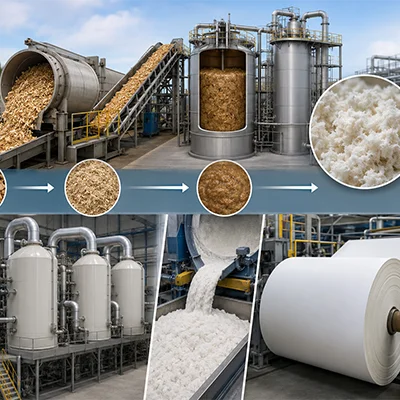
Understanding how wood converted into paper pulp in industry is requires examining the sequential operations performed inside a modern pulp mill.
The general workflow includes:
1. Log Receiving
Logs arrive from forests or plantations and undergo inspection for size, moisture, species, and quality.
2. Debarking
Rotating drum debarkers remove bark before chipping. Removing bark improves pulp quality and reduces contaminants.
3. Wood Chipping
Large logs are converted into uniformly sized chips using industrial chippers. Uniform chip size is essential for consistent cooking and fiber separation.
4. Chip Screening
Oversized and undersized chips are removed to maintain consistent processing conditions.
5. Pulping
The prepared chips enter digesters or refiners depending on the selected pulping method.
6. Washing
Pulp washing removes dissolved lignin, spent chemicals, and impurities.
7. Screening
Pressure screens eliminate knots, uncooked chips, and oversized particles.
8. Bleaching (When Required)
Bleaching increases pulp brightness for printing, writing, and tissue applications.
9. Thickening and Storage
The cleaned pulp is dewatered and stored before being sent to the paper machine.
These operations represent the primary steps in pulp production for paper manufacturing plants.
Major Types of Pulping Methods
Modern mills generally employ three major pulping technologies:
- Chemical pulping
- Mechanical pulping
- Semi-chemical pulping
Each offers distinct advantages depending on product requirements.
Chemical Pulping Process
The chemical pulping process removes lignin through chemical reactions while preserving cellulose fibers.
Unlike mechanical pulping, chemicals dissolve lignin rather than physically separating fibers.
The most common chemical pulping systems include:
- Kraft process
- Sulfite process
- Soda process
Among these, the Kraft process dominates global pulp production due to its superior fiber strength and chemical recovery capabilities.
Kraft Process
Wood chips are cooked inside pressurized digesters with white liquor containing:
- Sodium hydroxide
- Sodium sulfide
Cooking temperatures typically range between 150°C and 180°C.
During cooking:
- Lignin dissolves
- Fibers separate
- Cellulose remains largely intact
The pulp is then washed, screened, and optionally bleached.
Advantages
- Strong fibers
- High-quality pulp
- Excellent chemical recovery
- Suitable for packaging grades
- Good adaptability to different wood species
Limitations
- Higher capital investment
- Greater process complexity
- Odor management requirements
Mechanical Pulping Process
The mechanical pulping process separates fibers primarily through mechanical energy rather than chemical dissolution.
Most lignin remains within the fibers, resulting in high fiber yield.
Common mechanical methods include:
Stone Groundwood (SGW)
Logs are pressed against rotating grindstones.
Refiner Mechanical Pulp (RMP)
Wood chips pass through rotating disc refiners.
Thermomechanical Pulp (TMP)
Steam softens chips before refining.
Chemi-Thermomechanical Pulp (CTMP)
A mild chemical treatment precedes thermomechanical refining, improving fiber quality.
Advantages
- Very high fiber yield
- Lower raw material waste
- Lower chemical usage
- Lower capital cost
Limitations
- Higher electricity consumption
- Reduced fiber strength
- Lower brightness stability
- Paper yellows over time
Mechanical pulp is widely used in:
- Newsprint
- Magazines
- Catalogs
- Tissue blends
- Paperboard
Chemical vs. Mechanical Pulping Process Explained
Understanding the chemical vs. mechanical pulping process explained helps manufacturers select the appropriate technology.
| Feature | Chemical Pulping | Mechanical Pulping |
| Fiber Yield | 45–55% | 85–95% |
| Fiber Strength | Excellent | Moderate |
| Chemical Usage | High | Low |
| Electricity Demand | Moderate | High |
| Brightness Stability | Excellent | Lower |
| Capital Investment | Higher | Lower |
| Product Quality | Premium | Economy |
| Typical Products | Printing paper, packaging, specialty papers | Newsprint, tissue blends, paperboard |
Many integrated mills combine both technologies to balance quality, production costs, and sustainability.
Pulp Manufacturing Stages
Although individual mills differ, the major pulp manufacturing stages generally include the following:
Raw Material Preparation
Incoming wood undergoes:
- Debarking
- Chipping
- Screening
- Storage
Uniform feedstock improves digester performance and pulp consistency.
Fiber Separation
This is the core pulping operation.
Depending on the technology:
- Chemicals dissolve lignin.
- Refiners mechanically separate fibers.
- Hybrid systems combine both approaches.
Washing
Counter-current washing systems remove:
- Black liquor
- Dissolved lignin
- Residual cooking chemicals
Efficient washing reduces bleaching chemical consumption.
Screening and Cleaning
Modern pulp mills employ:
- Pressure screens
- Hydrocyclones
- Centrifugal cleaners
These systems remove contaminants without damaging fibers.
Bleaching
Bleaching improves brightness while preserving fiber strength.
Modern bleaching sequences may include:
- Oxygen delignification
- Chlorine dioxide
- Hydrogen peroxide
- Ozone
- Oxygen stages
Elemental chlorine-free (ECF) and totally chlorine-free (TCF) bleaching technologies have become increasingly popular due to environmental regulations.
Thickening
Water removal reduces transportation costs and improves storage efficiency.
Equipment includes:
- Drum thickeners
- Disc filters
- Screw presses
Storage
High-consistency pulp is stored in towers before being sent to paper machines.
Automated inventory systems ensure continuous production.
Steps in Pulp Production for Paper Manufacturing Plants
The complete steps in pulp production for paper manufacturing plants can be summarized as follows:
- Wood harvesting
- Transportation
- Log storage
- Debarking
- Chipping
- Chip screening
- Chip storage
- Pulping
- Washing
- Screening
- Cleaning
- Oxygen delignification
- Bleaching
- Thickening
- Pulp storage
- Delivery to paper machines
Each stage is monitored using advanced process control systems to maintain consistent pulp quality and optimize resource efficiency.
Technologies Transforming Modern Pulp Production
Today's pulp mills increasingly rely on digital technologies to enhance productivity, efficiency, and sustainability.
Advanced Process Automation
Distributed control systems (DCS) and programmable logic controllers (PLCs) continuously regulate:
- Digester temperature
- Pressure
- Chemical dosage
- Flow rates
- Washing efficiency
Automation minimizes process variability and improves pulp consistency.
Online Quality Monitoring
Real-time sensors measure:
- Fiber length
- Brightness
- Kappa number
- Consistency
- Moisture
Operators can make immediate adjustments to maintain product specifications.
Chemical Recovery Systems
In Kraft mills, recovery boilers regenerate cooking chemicals while producing steam and electricity.
Benefits include:
- Reduced chemical costs
- Lower waste generation
- Improved energy efficiency
Energy Optimization
Modern mills employ:
- Heat recovery systems
- High-efficiency motors
- Variable frequency drives
- Steam optimization
- Waste heat recovery
These technologies significantly reduce operating costs.
Artificial Intelligence and Data Analytics
AI-based platforms analyze production data to:
- Predict equipment failures
- Optimize chemical consumption
- Improve fiber yield
- Reduce downtime
- Enhance production planning
Predictive maintenance has become increasingly valuable in minimizing unexpected shutdowns.
Sustainability in Modern Wood Pulping
Environmental responsibility has become a strategic priority across the pulp and paper industry.
Leading manufacturers invest in:
- Sustainable forestry
- Certified wood sourcing
- Closed-loop water systems
- Reduced freshwater consumption
- Energy-efficient equipment
- Carbon emission reduction
- Waste-to-energy technologies
- Fiber recycling
Many facilities now operate integrated biorefineries that generate renewable energy from process by-products, improving both environmental performance and operational economics.
Choosing the Right Pulping Method
Selecting the appropriate pulping technology depends on several operational considerations.
Manufacturers evaluate:
- Target paper grade
- Fiber strength requirements
- Raw material availability
- Capital investment
- Operating costs
- Energy prices
- Environmental regulations
- Production capacity
- Water availability
- Sustainability objectives
Rather than relying exclusively on one technology, many paper producers adopt hybrid production strategies that combine mechanical, chemical, and recycled fiber streams to maximize flexibility and competitiveness.
Future Outlook
The future of pulp production is being shaped by automation, digitalization, sustainability, and circular manufacturing. Advanced sensors, AI-driven process optimization, low-carbon energy systems, and innovative bleaching technologies are enabling mills to improve productivity while reducing environmental impact.
At the same time, growing demand for sustainable packaging, tissue products, specialty papers, and fiber-based alternatives to plastics is creating new opportunities for innovation in wood pulping technologies. As manufacturers invest in smart mills and resource-efficient operations, the pulping process will remain a critical foundation of high-quality paper manufacturing, supporting both economic performance and long-term environmental stewardship.
Conclusion
The pulping process forms the backbone of every successful paper manufacturing operation. From preparing raw wood to producing high-quality paper pulp, each stage plays a vital role in determining fiber quality, production efficiency, and environmental performance. Whether utilizing a chemical pulping process for premium-strength papers or a mechanical pulping process for high-yield applications, manufacturers must carefully align technology choices with product requirements and sustainability goals.
Understanding how is wood converted into paper pulp in industry, the various pulp manufacturing stages, and the steps in pulp production for paper manufacturing plants enables industry professionals to make informed decisions regarding process optimization and investment. As digital technologies, automation, and eco-friendly innovations continue to transform the sector, modern pulp mills are well-positioned to deliver higher efficiency, improved resource utilization, and sustainable growth for the evolving global paper industry.
 Our Services
 Media Pack Download
 Newsletters
 Industrial Events