Industrial Kraft Paper Grades for Paper Sacks: Strength, Performance and Applications in Bulk Material Handling
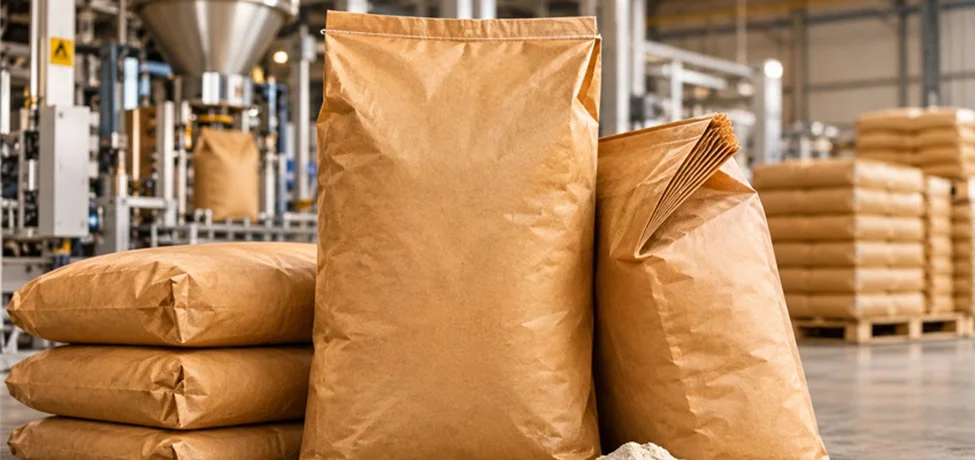
Every day, millions of paper sacks carry cement, fertiliser, flour, sugar, chemicals and minerals across the world. They are lifted, stacked, dropped, transported over long distances and stored in conditions that are rarely ideal. The material that holds up through all of this is a few thin layers of paper.
That is the engineering behind industrial paper sacks. The paper itself rarely gets attention, but packaging managers, procurement teams and converters know that the choice of kraft paper grade largely decides whether a shipment arrives intact or as split bags and wasted product.
This article explains how the main grades differ, why strength matters in bulk material handling, and how to choose the right paper for your product and filling process.
What is sack kraft paper, and why is it different from ordinary kraft?
Sack kraft paper is a specialty paper made mostly from virgin softwood pulp cooked by the kraft (sulphate) process. The long, strong fibres that process preserves are what give sack paper its toughness. Ordinary wrapping or bag-making kraft is built to look decent and fold well. Kraft sack paper is built to absorb shock.
The key difference is that sack paper has to be strong and forgiving at the same time. A stiff, brittle sheet might pass a tensile test and still burst when a filled bag hits the ground. Good sack paper stretches a little, absorbs the energy of the impact and holds together.
Which kraft paper grades are used in industrial paper sack manufacturing?
There are four main families. Each solves a different problem.
Natural brown kraft is the workhorse. Unbleached, economical and strong, it makes up the bulk of cement, fertiliser, chemical and mineral packaging. Its colour comes from the lignin left in the pulp, which also helps its durability.
Extensible kraft is the performance upgrade. During manufacture the sheet is mechanically compressed so it can stretch noticeably more before breaking, often around 6 percent or more in the machine direction, compared with roughly 2 to 3 percent for conventional paper. That stretch is what lets a bag survive a drop test. For heavy fills and rough logistics, extensible kraft is usually the grade that separates a sack that holds from one that doesn’t.
Bleached or white kraft is used where appearance or purity matters. Food, flour, sugar, pet food and consumer-facing products often use it as an outer ply or throughout. It prints sharply and looks clean on a shelf. The bleaching process costs some strength compared with natural kraft, so converters usually compensate with basis weight or ply count.
Wet-strength and treated kraft handle moisture. Resin-treated or coated papers keep their integrity in humid ports, outdoor storage and monsoon-season transport. If your goods sit in a godown near the coast, this grade deserves a serious look.
You may also see machine-glazed (MG) kraft, which has one smooth, glossy side. It is used for lighter packs and as a printing surface where the sack has to look neat.
How does sack kraft paper strength affect bulk material packaging?
This is the question that decides whether a spec sheet is useful. Strength is not one number. Several properties work together, and each one protects against a different kind of failure.
Tensile strength is how much pulling force the paper resists. It matters when bags are lifted, stacked and carried by their ends.
Tensile energy absorption (TEA) is arguably the most important figure for sacks. It measures how much energy the paper can soak up before failing. Two papers can have the same tensile strength and very different TEA. The one with higher TEA survives drops. If a supplier can only quote tensile strength, ask for TEA.
Burst strength reflects resistance to pressure from inside, which is relevant when dense powders press outward against the walls.
Tear resistance keeps a small nick from turning into a split down the whole bag.
Porosity is the surprising one, and the next section explains why.
When a sack fails in the field, the cause is usually a mismatch. A heavy, abrasive product like cement needs high TEA and tear resistance. A fine, light powder like flour needs controlled porosity and cleanliness. Choosing on price per tonne alone, without matching properties to the product, is the most common and most expensive mistake in bulk packaging.
Why does multiwall construction matter?
Most multiwall paper sacks use two to four plies rather than one thick sheet. This is smarter engineering than it looks.
Layered thin plies are stronger than a single ply of the same total weight. When one ply is stressed, the others share the load, and a flaw or pinhole in one layer doesn’t line up with a flaw in the next. Plies are not usually glued across their full surface. They can slide slightly against each other, which helps the sack absorb impact.
Designers can also mix grades across plies. An outer ply might be printable white or natural kraft, the middle plies extensible kraft for impact strength, and the inner ply chosen for barrier or cleanliness. A moisture barrier such as a polyethylene film or a laminated layer can be added where the contents are sensitive. This layering is what makes bulk packaging materials based on paper so adaptable, from 5 kg consumer packs to 50 kg industrial fills.
Selecting the right kraft paper for industrial valve sacks
Valve sacks are filled through a small sleeve in one corner, at speed, by machines that blow or push product in. The sack then seals itself under the weight of its contents. They dominate cement and many powder applications because they fill fast and stack neatly.
Here, porosity becomes critical. Air has to escape while the powder goes in. If the paper is too tight, bags fill slowly, balloon and burst. If it is too open, fine powder leaks out and dusts the whole line. The right balance depends on your filling machine, your product’s particle size and your target speed.
For industrial valve sacks, a sensible approach looks like this:
• Start with the product: its density, abrasiveness and fineness.
• Match the fill method to porosity. Air-pack fillers need more breathable paper than gravity fillers.
• Choose extensible kraft for the plies that take the drop impact.
• Check the valve and bottom seams as well as the paper. Many “paper failures” are really seam or adhesive failures.
• Trial a batch on your own line before committing to a full run.
Kraft sack paper for food packaging: what changes?
Food changes the priorities. Strength still matters, but safety and cleanliness move to the top.
Bleached or light-coloured kraft is common here, partly for looks and partly because it signals cleanliness. More important, the paper must be suitable for food contact. Buyers should ask for compliance documentation relevant to their market, such as FSSAI requirements in India or international standards like EU and FDA food-contact rules. Reputable mills also hold food safety certifications such as FSSC 22000 or BRC.
Moisture and odour control matter too. Flour, rice, sugar and spices absorb smells and humidity, so many food sacks add an inner liner or barrier ply. Cross-contamination from inks and adhesives deserves a question to your converter. If a supplier can’t answer clearly, treat that as a warning sign.
Does “high-strength kraft paper” always mean heavier paper?
No, and this is worth knowing, because it can save money. High-strength kraft paper is not simply thicker paper. Modern mills increase performance through better fibre selection, refining and mechanical treatment such as extensibility, rather than just adding grams per square metre.
That means a well-engineered 70 gsm extensible sheet can outperform a heavier conventional sheet in drop tests. Lighter plies also cut freight weight, raw material use and carbon footprint. Paper sacks have a good sustainability story to begin with: they are renewable, recyclable and biodegradable. Downgauging, meaning using lighter but smarter paper, strengthens that story further.
Common mistakes buyers make
A few patterns come up again and again:
1. Specifying by gsm alone. Weight tells you little about performance. Ask for TEA, tear, burst and porosity.
2. Ignoring the supply chain. A sack that handles a 50 km trip fine may fail on a 1,500 km journey with multiple handlings.
3. Skipping real-world testing. Lab data helps, but drop tests, stacking tests and line trials reveal what spreadsheets can’t.
4. Overlooking moisture. One monsoon season can undo a spec written for dry conditions.
5. Chasing the lowest price. A cheap sack that splits costs far more in lost product, cleanup and customer trust.
Quick answers
What is the best kraft paper grade for cement bags?
Natural brown extensible kraft, usually in three or four plies, with porosity matched to the filling machine.
Is white kraft weaker than brown kraft?
Generally, somewhat, because bleaching reduces some fibre strength. Converters often adjust weight or ply count to compensate.
How many plies does a paper sack need?
It depends on fill weight and handling. Two to four plies cover most industrial uses.
Can paper sacks be moisture resistant?
Yes, through wet-strength paper, coatings or inner liners and barrier plies.
Are paper sacks recyclable?
Plain kraft sacks are widely recyclable and biodegradable. Added plastic layers can complicate recycling, so ask your supplier what is used.
The takeaway
Choosing among kraft paper grades is not a matter of picking the strongest sheet on the datasheet. It is about matching paper properties to your product, your filling line and your logistics chain. Get that match right and the sack nobody notices does its job quietly, all the way from plant to customer. Get it wrong and everyone notices.
If you are specifying multiwall paper sacks for a new product or reviewing a current supplier, start with the questions this article raises: What is the TEA? What porosity suits my filler? What does the product need in terms of barrier and food safety? The answers will tell you more than the price quote ever will.
 Our Services
 Media Pack Download
 Newsletters
 Industrial Events