Quench Towers & Condensers
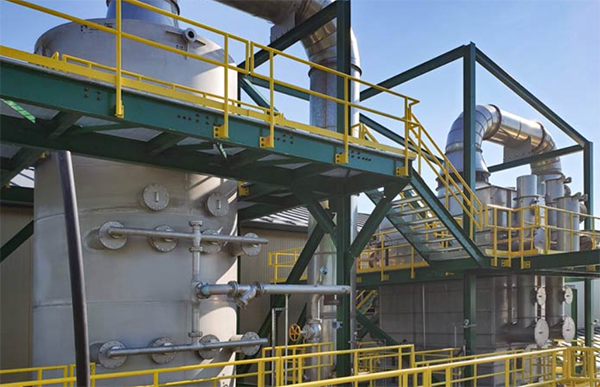
Monroe Quench Towers & Condensers
Monroe Environmental engineers have the experience to provide a customized Quench Tower design that will meet the needs of your application without the use of excessive water consumption. Using the air temperature and moisture content (lb. water per lb. of dry air), the temperature at full saturation can be predicted. Systems which require only partial saturation to meet specific temperature targets can also be designed by Monroe engineers.
Quench Tower Design
Quench Tower in fabrication
The proper design of a Quench Tower takes into account many factors, including:
Inlet temperature
Inlet moisture content
Target temperature
Target moisture content
Effect of quenching on particulate formation and control
Chemicals present is air/gas stream
Velocity of the gas stream and gas retention time
Nozzle design and spray patterns
Materials of construction to withstand temperature and chemical attack
And many others
Monroe Environmental can assess these and other application factors and custom design a quench tower that is suitable for your application.
Quench Materials of Construction
The materials of construction are especially important as they must be selected to both withstand attack from the various pollutants contained within the airstream and be resistant to high incoming temperatures. Common materials of construction include:
Hastelloy
AL6XN steel
Duplex stainless steel
304 and 316 stainless steel
Refractory and ceramic linings
Other specialty alloys