Water Quality Monitoring and Chemical Control in Paper Mills
Introduction: Why Water Intelligence Defines Modern Paper Manufacturing
Water is the lifeline of the paper manufacturing process as it affects the preparation of the fibers, sheet formation, the quality of its finishing, and environmental compliance. With the paper mills shifting to a higher productivity, quality control and stricter environmental standards, the traditional methods of water management do not allow. The modern mills demand genuine, immediate water quality supervision apparatuses combined with the accurate chemical handling of water treatment to ensure stable functioning and control.
As the pressure on water use and the effluent treatment increases, as well as the reduction of chemicals is taken into consideration, automated systems of monitoring industrial water are getting compulsory and not optional. This has been changed by the necessity to measure the turbidity and water quality accurately, to have accurate chemical dosing to control effluent treatment systems, and meticulous process optimization throughout the whole water lifecycle in paper mills.
Water Circuits in Paper Mills and Their Quality Challenges
The paper mills have complicated and interconnected water circuits consisting of raw water intake, process water loops, white water recovery, and effluent discharge. Different circuits pose different water quality challenges which have a direct impact on machine efficiency and end-paper properties.
Turbidity, hardness and organic load of raw water can change seasonally thus regular treatment cannot be achieved. Dissolved solids, fines, fillers, and leftover chemicals get built up in process water and cause scaling, deposition, and micro-growth. Effluents also have suspended solids, chemical oxygen demand and color, which have to be regulated prior to discharge or reuse.
These complications require sustained turbidity and filtration of industrial wastewater, where automated monitoring of water quality of the paper mills assists in identifying changes in water quality even before it turns into a production or compliance problem.
Understanding Water Quality Monitoring Systems in Paper Mills
Modern paper mills have water quality monitoring systems that are aimed at offering real-time and continuous knowledge of such critical parameters as turbidity, pH, conductivity, dissolved solids, and temperature. Automated systems are free of delays, human error, unlike manual sampling techniques and thus, proactive decisions are made.
Industrial turbidity measurement instruments are in the centre stage of this ecosystem. Turbidity can be used as an indicator of the concentration of suspended solids, fiber carryover and efficiency of treatment. Turbidity and water quality determination is an accurate way of making sure that mills recognize inefficiency in clarification, filtration, and chemical dosing processes.
State-of-the-art automated industrial water monitoring systems combine on-line sensors and central control systems. These systems keep sending data to distributed control systems or plant SCADA platforms to enable operators to correlate the water quality trends with machine performance, chemical usage and effluent quality.
Industrial Turbidity Measurement Tools and Their Role in Process Stability
In paper mills, turbidity measurement is much more than a compliance measure, it is a process optimization measure. The industrial turbidity measurement instrument is mounted in key locations like the entry of raw water, clarifiers, save-alls, filtration units, and discharge lines of the effluent.
Turbidity is commonly associated with high levels of poor retention, fiber loss or weak clarification. The trends in turbidity are used in effluent treatment systems to understand the efficacy of coagulation, flocculation, and filtration processes. Stable downstream biological treatment and reduction of the possibility of violating the regulation is guaranteed by reliable turbidity control and filtration in industrial wastewater.
Contemporary turbidity sensors are constructed to handle the severe factory environment, such as solid concentration, temperature fluctuation, and chemical exposure. These tools can also provide real-time feedback loops of chemical dosing control when used together with automated water quality monitoring of paper mills.
Water Treatment Chemical Dosing in Paper Mills
Dosing of water treatment chemicals is an important lever to sustain water quality, efficiency of the process and the performance of the environment. Paper mills depend on various chemicals such as coagulants, flocculants, pH modifiers, biocide as well as the scale inhibitors. Efficacy of such chemicals requires selection and also responsive and correct dosing.
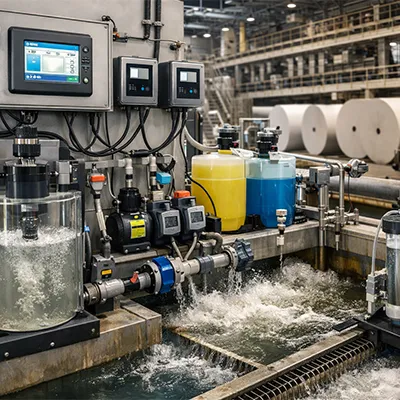
Fixed-rate or manual dosing can frequently result in either overdose or under dose of chemicals which adds to the cost of operation and disrupts the treatment procedure. The mills are controlled by automated, real-time water quality monitors, with the dosing rate controlled by automated water treatment chemical dosing system which adjusts based on the real conditions of the process.
This is because such a dynamic method facilitates the achievement of chemical control in water treatment after matching dosing to the turbidity, rate of flow and contaminant loads so that the performance remains even under different operating conditions.
Coagulant Dosing Systems and Clarification Efficiency
At the core of both process water treatment and effluent treatment system, there are coagulant dosing systems that are used in solid-liquid separation. Coagulants are used to neutralise the electrical charge of suspended particles to allow aggregation and settlement or filtration to occur.
Variations in the fiber content, filler concentration, and dissolved organics may have a significant effect on coagulation in paper mills. Coagulant dosing systems combined with turbidity sensors are automated and will automatically increase and decrease the dosing rate to achieve the best clarification efficiency.
Mills can obtain a consistent reduction in turbidity by connecting coagulant dosing systems and automated monitoring systems that will allow them to reduce the turbidity of their water using minimal amounts of chemicals. This integration is the direct support of the chemical dosing of effluent treatment systems and enhanced sludge dewatering performance further down the line.
Automated Industrial Water Monitoring Systems: From Data to Decisions
The integration of sensor technology, automation and digital intelligence can also be seen in automated industrial water monitoring systems. These systems gather real time information at various monitoring points and transform it into operator and engineer actionable information.
The automated monitoring platforms are used in paper mills to do trend analysis, manage alarm, and predictive maintenance. As an example, gradual rise in turbidity at a filtration outlet can be used to indicate media fouling or chemical underdosing way before compliance can be broken.
The use of automated water quality monitoring of paper mills helps sustainability efforts as well by saving water through reusing, minimizing freshwater consumption, and maximizing effluent treatment effectiveness. Such systems, in combination with advanced analytics, can assist mills to benchmark their performance and keep water performance improving.
Chemical Dosing Control for Effluent Treatment Systems
Paper mills have variable loads of suspended solids, organic matter and residual chemicals that have to be treated through effluent treatment. To even out the performance of treatment under changing conditions of production, the effluent treatment systems need chemical dosing control to ensure the effluent treatment performance at varying levels of production.
Automated dosing systems are triggered by real time data of turbidity and measurement of water quality, which is used to vary chemical input in order to maintain a desired effluent quality. This practice minimizes shock actions on the bio-treatment phases besides facilitating consistent adherence to the discharge criteria.
Chemical control of water treatment also minimizes the production of sludge, minimizes the cost of chemicals used, and increases the reliability of the plant as a whole. Automated dosing control is a very important risk control mechanism to mills that work on the basis of stringent environmental policies.
Short Industry Table: Key Water Quality Parameters and Their Impact
| Parameter | Operational Impact in Paper Mills | Monitoring Importance |
| Turbidity | Indicates fiber loss and treatment efficiency | Critical for process and effluent control |
| pH | Affects chemical performance and corrosion | Essential for dosing accuracy |
| Conductivity | Reflects dissolved solids buildup | Important for water reuse decisions |
| Flow Rate | Influences dosing calculations | Required for automated control |
| Temperature | Impacts reaction kinetics | Supports process optimization |
Industry Q&A: Practical Insights for Paper Mill Decision-Makers
The most frequent inquiry among the plant managers is on whether automated water quality monitoring systems are worth their investment. Less down time, less chemical utilization and higher reliability on compliance are the solution to this and they usually become pay-back within a brief period in operation.
The other common issue is the maintenance of sensors.
The modern day industrial turbidity measurement devices are built with minimal maintenance and are also self-cleaning thus are applicable in continuous mill operation.
Another question that is posed by executives is the impact of automation on staffing. Instead of substituting staff members, automated systems can make operators more effective by decreasing manual sampling and providing the capability to make decisions based on data.
Glossary of Key Terms
Automated industrial water monitoring systems are referred to as combined systems that constantly monitor and observe the water quality parameters in real time.
Coagulant dosing systems are automatic devices through which the dosage of coagulant agent used in encouraging solid liquid separation is maintained.
The filtration and turbidity control in industrial wastewater can be used to define the combination of measurement and physical separation process to lower the suspended solids.
Chemical control is used in water treatment to control the kind, amount, and timing of the additions of chemicals in order to achieve the desired water quality.
The Strategic Value of Integrated Water Management in Paper Mills
Under the pressure to become more efficient, sustainable, and meet regulatory compliance requirements, water quality monitoring and chemical control become strategic enablers and not operation requirements by paper mills. Paper mills are monitored automatically on their water quality and to maintain the performance of the treatment, the sophisticated chemical dosing control can be followed over the complex water circuits.
When industrial turbidity measurements systems are incorporated with automated chemical control systems, a closed-loop development is established, which improves the reliability of the processes, minimizes the wastes, and helps to maintain the competitiveness in the long term. When mills invest in such technologies, they place themselves at a position to satisfy the future standards of environmental requirement and maximize the production economics.
Conclusion: Building Resilient Paper Mills through Smart Water Control
The key to resilient water treatment to paper mills in future is water quality monitoring systems, and chemical control in water treatment. Through implementing automated industrial water surveillance systems, accurate coagulant dosing systems and smart turbidity and water quality measurement, mills will attain predictive product quality, reduced operational expenses, and improved environmental performance.
With a close enough margin in an industry and a high standard of compliance, the precision of water quality control ceases to be a technical enhancement, but a matter of business necessity.
 Our Services
 Media Pack Download
 Newsletters
 Industrial Events