Paper Die Cutting Machines: Choosing the Right Machinery for Paper Products
The short answer
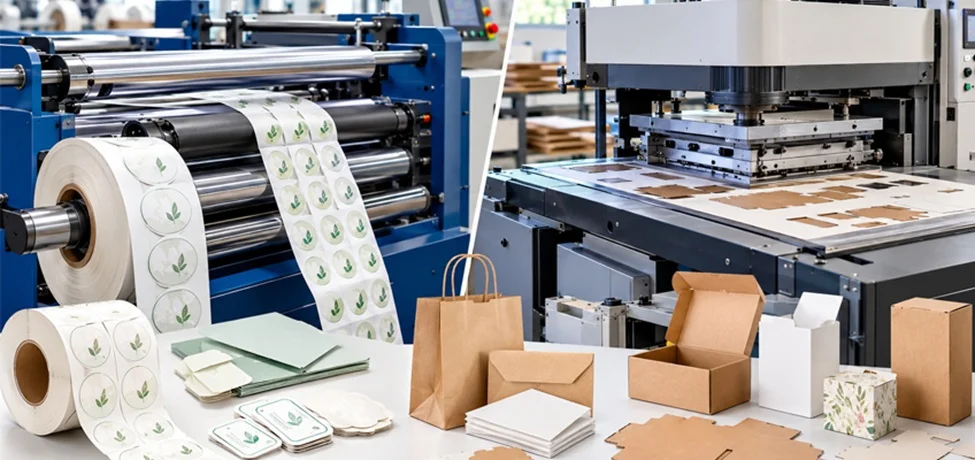
Choose a rotary die cutting machine for long, high-speed runs of simple to moderately complex shapes, like labels, envelopes, and folding cartons in volume. Choose a flatbed die cutting machine for thicker boards, intricate shapes, and short to medium runs where flexibility matters more than raw speed. Your material thickness, order size, and shape complexity should decide it, not the machine’s price tag.
That’s the answer in two sentences. The rest of this guide explains the why, so you can spend your money with confidence.
What is a paper die cutting machine?
A paper die cutting machine uses a custom-shaped steel tool, called a die, to cut, crease, perforate, or emboss paper and paperboard into repeatable shapes. Think of it as a very precise, very powerful cookie cutter for paper.
Every box, shopping bag, label, folder, and greeting card you’ve ever held probably passed through one. The machine presses the die against the material with controlled force, and out comes a clean, identical part, thousands of times over.
You’ll hear a few names for the same family of equipment: die cutting machine, paper die cutter, die cutting machinery, and paper cutting equipment. In practice they overlap, though “paper cutting equipment” can also include guillotine cutters, which only make straight cuts. A die cutter makes shaped cuts. That difference matters when you’re comparing quotes.
The two main types: rotary and flatbed
Almost every buying decision comes down to this choice, so let’s make it simple.
How rotary die cutting works
In rotary die cutting, the die is wrapped around a cylinder. The material feeds continuously between that cylinder and an anvil roller, and cutting happens as everything rotates. There’s no stop-start motion, which is why it’s so fast.
Where it shines:
- Very high speeds, often several times faster than flatbed for suitable jobs
- Continuous web-fed material like roll labels and tapes
- Long runs where the setup cost spreads thin across thousands of pieces
- Consistent results with little operator intervention
Where it struggles:
- Dies are costly to make, so short runs rarely pay off
- Thick or rigid boards are harder to handle
- Very intricate patterns and deep creasing can be limited
How flatbed die cutting works
In flatbed die cutting, the die sits on a flat plate. The material is placed or fed into position, and a press stamps the die down onto the sheet, like a stamp hitting an inkpad. Many modern flatbed machines feed sheets automatically and strip waste in the same pass.
Where it shines:
- Thick paperboard, corrugated board, and heavy stocks
- Complex shapes, tight tolerances, and combined cut-and-crease work
- Cheaper dies (flat dies cost less to produce than rotary tooling)
- Short to medium runs and frequent job changes
Where it struggles:
- Slower cycle times because of the stop-start motion
- Higher labor involvement on manual or semi-automatic models
Rotary vs flatbed die cutting for paper products: side-by-side
|
Factor |
Rotary Die Cutting |
Flatbed Die Cutting |
|
Speed |
Very high, continuous |
Moderate, intermittent |
|
Best run length |
Long (tens of thousands+) |
Short to medium |
|
Die cost |
Higher |
Lower |
|
Material thickness |
Thin to medium |
Thin to very thick |
|
Shape complexity |
Simple to moderate |
Simple to highly complex |
|
Material format |
Rolls (web) or sheets |
Mostly sheets |
|
Setup time |
Longer initially, fast repeats |
Quicker changeovers |
|
Typical products |
Labels, envelopes, tapes, bags |
Cartons, rigid boxes, displays, folders |
If you remember only one rule: rotary wins on volume, flatbed wins on versatility.
How to choose paper die cutting machinery: six questions to ask first
Before you request a single quote, answer these. They’ll narrow your options faster than any brochure.
1. What are you actually making?
Be specific. A roll of adhesive labels and a luxury cosmetic carton are entirely different jobs. Labels and envelopes lean rotary. Cartons and rigid packaging lean flatbed.
2. How thick is your material?
Measure it in GSM or caliper. Lightweight paper and thin stock handle rotary well. Heavy paperboard and corrugated almost always call for flatbed pressure.
3. What are your typical order quantities?
This is the biggest cost driver. If most orders are under a few thousand pieces, expensive rotary tooling will eat your margin. If you regularly run hundreds of thousands, flatbed will bottleneck you.
4. How complex are your designs?
Intricate windows, fine perforations, and multi-level creases favor flatbed. Repeating simple shapes favor rotary.
5. What does your changeover look like?
Do you switch jobs five times a day or once a week? Frequent changes reward machines with fast die swaps and easy registration.
6. What’s your real budget, including everything?
Count the machine, dies, installation, training, spare parts, and maintenance. A cheaper machine with expensive consumables can cost more over three years than a pricier, efficient one.
Matching machinery to paper packaging production
If your focus is die cutting machines for paper packaging production, here’s how most manufacturers approach it:
- Folding cartons (food, cosmetics, pharma): Flatbed die cutters, often with automatic feeding and waste stripping. They handle creasing and cutting together with clean, crisp folds.
- Corrugated boxes and shipping packaging: Heavy-duty flatbed or specialized corrugated die cutters built for thicker, rigid material.
- Paper bags and envelopes: Rotary, thanks to the speed and simple profiles.
- Labels and stickers: Rotary, especially web-fed systems that cut, strip, and rewind in-line.
- Short-run custom or premium packaging: Flatbed, sometimes paired with digital finishing for personalization.
Many growing converters end up owning both types. Start with the one that matches 70 to 80 percent of your orders, then add the second when demand justifies it.
Common mistakes to avoid
Buying for the dream order, not the daily order. A machine sized for the one big contract you hope to win may sit underused on your actual workload.
Ignoring die quality. The machine gets the attention, but a poorly made die ruins cuts regardless. Budget for good tooling and a reliable die supplier.
Skipping the material test. Always ask the supplier to run your paper stock on their machine before you buy. Specs on a datasheet and real-world cutting behavior can differ.
Forgetting about service. Downtime is expensive. Ask about local technicians, spare parts availability, and response times before signing anything.
Overlooking operator skill. A machine is only as good as the person setting it up. Factor in training, especially for flatbed machines with manual makeready.
Maintenance basics that protect your investment
Whichever type you choose, a few habits extend its life:
- Clean dust and paper debris daily, since build-up affects cut accuracy
- Inspect dies regularly for dull edges or damage
- Check pressure settings and anvil or cutting plate wear
- Lubricate moving parts on schedule
- Keep a log of problems so patterns show up early
Small routines prevent the expensive surprises.
Frequently asked questions
What is the difference between rotary and flatbed die cutting?
Rotary die cutting uses a cylindrical die and cuts continuously at high speed, ideal for long runs. Flatbed die cutting uses a flat die that presses down on the sheet, ideal for thicker materials, complex shapes, and shorter runs.
Which is faster, rotary or flatbed die cutting?
Rotary is generally faster because the process is continuous, with no pause between cuts.
Is flatbed die cutting cheaper than rotary?
Upfront tooling is usually cheaper for flatbed. Over very long runs, rotary often delivers a lower cost per piece because of its speed.
Can one die cutting machine handle all paper products?
Rarely. Most machines are optimized for a range of thickness, volume, and format. Businesses with diverse products often use both.
What should I look for when buying a paper die cutter?
Match it to your material thickness, typical run length, shape complexity, and available floor space, then check die costs, safety features, and after-sales support.
How long do die cutting machines last?
With proper maintenance, quality machines can run for well over a decade. Dies wear faster and need periodic replacement or resharpening.
Final thoughts
There’s no universally “best” paper die cutting machine, only the best fit for your products, volumes, and growth plans. Start with the questions above, test with your actual material, and be honest about what your orders look like today, not just what you hope they’ll look like next year.
Get that right, and your die cutting machinery will quietly pay for itself with clean cuts, less waste, and happier customers.
Ready to compare options? Share your material, thickness, and typical order size with your supplier and ask for a sample run. A good manufacturer will happily prove their machine on your paper.
 Our Services
 Media Pack Download
 Newsletters
 Industrial Events