How Digital Twin Technology Is Revolutionizing Air Handling Systems in Smart Paper Mills
Introduction
Air is vital in a paper mill, and more critical than many realize.
Air circulation within the premises can influence paper-drying, moisture control, dust control, paper machine performance and even comfort of the workers. Issues will often manifest within a short period when air flow is not consistent, such as paper quality issues, dust collection on machines, temperature fluctuations, higher energy costs, etc.
For years, mills handled these issues using conventional ventilation systems and routine maintenance schedules. Operators checked equipment manually, maintenance teams repaired failures when they happened, and ventilation settings often stayed unchanged for long periods.
That approach is slowly changing.
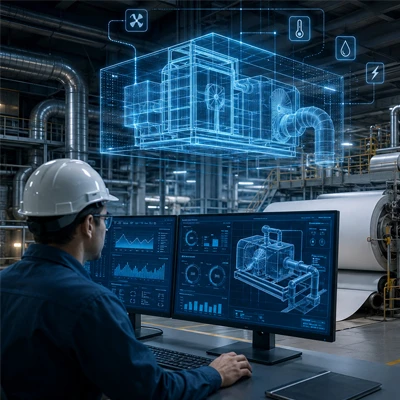
Paper companies are now investing in smarter technologies that provide them with greater insight into daily operations. One technology gaining attention is Digital Twin Technology. Instead of simply monitoring equipment, digital twins create a live digital model of physical systems and continuously update it using sensor data from the plant floor.
In many modern facilities, these systems are being connected to HVAC and ventilation infrastructure to improve Industrial Air Handling performance.
The timing makes sense. Operational inefficiency, old equipment, environmental regulations and high electricity bills are problems facing many paper mills. Ventilation systems are used nearly every minute of the day and so even minor changes to ventilation management can have a real impact on the bottom line.
That's why more facilities are implementing Digital Twin HVAC Systems and are incorporating them into their automation solutions.
The shift toward Smart Paper Mills is also encouraging manufacturers to modernize equipment that was previously managed manually. Now, ventilation systems are not regarded as utility devices anymore. They are now included in wider discussions concerning sustainability, reliability of production and energy efficiency.
Another reason for growing interest is maintenance. The failure of the HVAC system in the paper mill can cause production interruptions and costly downtime. Modern predictive HVAC systems allow facilities to detect warning signs earlier, and enable maintenance teams to take action before major failures.
AI also is beginning to impact industrial ventilation. New AI Powered Industrial HVAC Systems can analyze operating conditions and automatically adjust airflow according to production requirements.
At the same time, manufacturers are focusing more on Industrial Ventilation Energy Optimization because of growing sustainability goals and operating costs.
This article explores how Digital Twins for Paper Mills are being used in real manufacturing environments, why smart ventilation matters, and how digital systems are changing the future of air handling in the paper industry.
There is more to air handling than is generally realized
The outside world only looks at paper machines, pulping systems or production speed. Environmental control has a significant impact on a paper mill's efficiency.
During the paper making process, heat, moisture and very fine airborne particles are generated. In the absence of adequate ventilation these conditions may impact product quality and equipment reliability.
There are some common problems, such as:
- Excess humidity affecting paper consistency
- Dust buildup around machinery
- Uneven temperatures inside production zones
- Increased strain on motors and ventilation equipment
- Poor indoor air quality for employees
Older systems usually depend on fixed operating settings. Fans may run at the same speed all day, even when production conditions change. Maintenance is also commonly scheduled based on time intervals instead of actual equipment condition.
That can lead to wasted energy and delayed repairs.
As mills become more automated, companies are looking for Smart Air Handling Solutions that respond more accurately to what is happening inside the facility in real time.
What Digital Twin Technology Actually Does
The term sounds complex, but the basic idea behind Digital Twin Technology is fairly practical.
A digital twin is a virtual version of a real system. Sensors installed on physical equipment send continuous information to software that mirrors how the equipment is performing.
For Industrial Air Handling, the digital twin may receive data related to:
- Air pressure
- Fan speed
- Humidity levels
- Energy use
- Temperature
- Airflow balance
- Filter condition
Operators won't simply be able to view the system on an irregular basis, but can see the system in action, day in and day out.
The digital twin can detect airflow changes in one area and/or changes in power usage by a motor before the conventional monitoring system can.
This helps maintenance teams react before production is affected.
Better Visibility Across the Plant
Large paper mills often contain multiple ventilation units spread across different sections of the facility. Monitoring everything manually is difficult, especially in older plants.
This is one area where Digital Twin HVAC Systems are proving useful.
Rather than checking systems one by one, operators can monitor ventilation performance through centralized dashboards. Information from different air handling units appears in one place, making it easier to spot unusual behavior.
For example, if humidity suddenly rises in a drying section, the system may identify airflow problems immediately. The maintenance team can then investigate the problem before the product's quality drops.
This type of visibility also enhances the inter-departmental communication as everyone is operating on the same current information.
Predictive HVAC Systems Help Avoid Sudden Failures
One unexpected HVAC problem can create major disruptions inside a paper mill.
Ventilation failures may affect production temperature, dust control, or drying conditions. In facilities running continuously, downtime quickly becomes expensive.
Traditional maintenance approaches are often reactive. Equipment is repaired after it fails or serviced according to a calendar schedule.
Predictive HVAC Systems work differently.
Digital twins continuously monitor equipment condition and look for signs of developing problems. This may include:
- Unusual vibration patterns
- Higher motor temperatures
- Reduced airflow efficiency
- Pressure changes inside ducts
Instead of waiting for a breakdown, maintenance teams receive early warnings.
This allows mills to:
- Plan repairs more effectively
- Reduce emergency shutdowns
- Avoid unnecessary servicing
- Improve equipment lifespan
For many manufacturers, this maintenance advantage is one of the biggest reasons to invest in digital twins.
AI Powered Industrial HVAC Systems
AI is starting to be more involved in industrial ventilation systems.
Some newer AI Powered Industrial HVAC Systems can analyze operating patterns and make automatic adjustments without constant manual input.
This can mean sending more air into one part of the production if it heats up or is dustier than another. Ventilation intensity can be reduced during less busy production times to conserve energy.
This creates a more flexible system compared to older ventilation setups that operate at fixed levels.
The system can also be improved over time by the use of machine learning. The more data the software is given, the more patterns it can identify and make predictions about equipment.
The intent is to de-escalate human intervention, but to assist operators in their decision making process.
Industrial Ventilation Energy Optimization
One key issue for the paper industry is energy costs.
Ventilation systems are a large electricity user as they are working at all times during production cycles. No matter how small, any improvement in efficiency can save money in the long run.
That's why Industrial Ventilation Energy Optimization is becoming a more important part of smart manufacturing strategies.
Digital twins support energy optimization in several ways.
Dynamic Airflow Adjustment
Instead of running at constant output, smart systems can adjust airflow according to actual production conditions.
This minimizes the energy consumption that is not needed.
Identifying Inefficiencies
A digital twin can identify equipment which consumes more energy than anticipated. The maintenance team can then check the problem before it results in bigger losses in operation.
Long-Term Sustainability
There is a significant number of companies who are challenged in reducing emissions and reporting on sustainability. These objectives are assisted by more efficient ventilation systems.
Smart Ventilation for Paper Industry Operations
Paper factories are unique among industries for their requirements in regard to ventilation.
As a result, the humidity stability, dust extraction and temperature control are frequently the most critical features in Smart Ventilation for Paper Industry applications.
Humidity Management
Fluctuations in moisture can impact paper quality and production uniformity. More stable environmental conditions are achieved using smart ventilation systems.
Dust Control
Paper dust can create maintenance and safety problems if not controlled properly. Intelligent ventilation systems can automatically adjust extraction rates when dust levels increase.
Worker Conditions
Better airflow and temperature management also improve workplace comfort, particularly in warmer production areas.
Challenges During Adoption
While digital twins have numerous benefits, they still need to be planned and invested.
Older mills may need infrastructure upgrades before digital systems can integrate properly. Installing sensors and connecting equipment to centralized platforms can also take time.
Some manufacturers also face concerns related to:
- Employee training
- Data management
- Cybersecurity
- Initial installation costs
Despite this, many facilities view a digital twin as not a technology upgrade but rather as something in the distant future that will be part of the ongoing modernization process.
Looking Ahead
Digital technologies are increasingly seen in all manufacturing sectors and paper mills are unlikely to be exempted from this trend.
As technology advances, there is an increasing number of facilities that will be able to have smarter ventilation systems that will help them achieve their operational goals and sustainability objectives.
The potential for further enhancements includes improved AI capabilities, quicker predictive analysis and the development of more sophisticated remote monitoring systems.
Digital twins are likely to be a key investment area for mills aiming to minimize downtime and optimize their energy performance.
Conclusion
Ventilation systems have always played a role in paper-making, but are now more intelligent and data-driven than ever before.
With Digital Twin Technology, paper mills can track HVAC performance in greater detail, detect issues sooner and enhance their overall performance.
Predictive HVAC Systems, AI Powered Industrial HVAC Systems, and Smart Air Handling Solutions show the industry's commitment to reliability, sustainability, and smarter HVAC system management.
As Smart Paper Mills continue evolving, digital twins are expected to play an even larger role in improving Industrial Air Handling and supporting more efficient manufacturing operations.
 Our Services
 Media Pack Download
 Newsletters
 Industrial Events