How AI is Transforming Air Handling Systems in Paper Mills
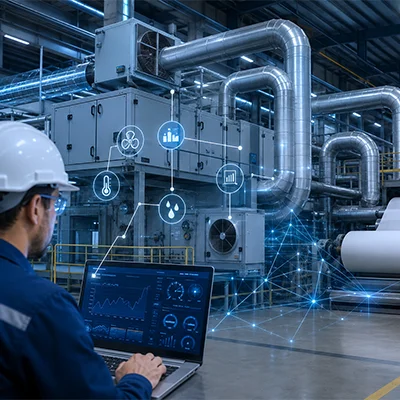
Inside a paper mill, conditions change almost every hour. Drying sections release heat continuously, moisture levels rise and fall during production, and fine paper dust spreads across work areas. Maintaining stable airflow in such an environment has never been simple.
Traditional air-handling systems have long been a key to balancing production floors at mills. The plant had these systems that controlled the ventilation, temperature, humidity and air-circulation. They were engineered to be reliable and not flexible.
That is becoming a challenge today.
Today, the paper industry has to meet more and more production deadlines, electric bills, and expectations for sustainable production. Facilities should enhance efficiency without causing disruptions to production or reducing paper quality. This has prompted many companies to reconsider the operation of their industrial HVAC systems within their plants.
A key change is the increasing adoption of AI in the manufacturing sector. Artificial intelligence is revolutionizing the operation of supporting infrastructure, even though automation is often seen as being connected to robotics and production machinery. Today, Air handling systems are increasingly becoming intelligent, responsive, and integrated with the actual plant condition.
Why Air Handling Systems Are Important in Paper Mills
Environmental control has always been a critical part of paper production.
Temperature changes can affect drying processes. Changes in humidity could affect paper size or coating. A build-up of dust can affect the efficiency and maintenance of machinery.
This is why air handling systems are considered essential infrastructure in paper mills.
These systems help facilities:
- Maintain airflow balance
- Regulate humidity levels
- Remove airborne fibers and dust
- Control indoor temperatures
- Support production stability
- Prevent machinery from becoming too hot
The difficulty is that production environments inside paper plants rarely remain constant.
Some sections generate excess heat while others require tighter moisture control. Production speed may change during the day, and seasonal weather conditions also affect indoor climate levels. In many cases, conventional systems are incapable of coping with the need for rapid adjustments as many continue to use fixed operations schedules.
In a handful of facilities, ventilation systems are still running at the same rate as before, no matter how much ventilation is needed. That increases unnecessary energy use.
With the consumption of a significant amount of electricity in paper production, efficiency has become a priority for many operators of industrial HVAC systems.
The move toward smarter HVAC operations
In today's manufacturing environment, there is a significant amount of operational data being generated by manufacturing facilities.
The sensors in the plant measure air flow pressure, humidity, machine vibration, equipment temperature and energy consumption. When this information was manual much of it had to be reviewed.
With AI software, these readings can now be analyzed on the fly and patterns of operation can be found in real-time.
This is where AI in air handling systems begins to make a practical difference.
Instead of waiting for operators to respond manually, systems can adjust automatically according to changing production conditions.
For example, if humidity levels begin rising near a drying section, ventilation can increase immediately. If one production area slows down, airflow in that zone can decrease to conserve electricity.
The system reacts according to what is actually happening inside the facility rather than following a fixed schedule.
That level of responsiveness is one reason manufacturers are investing more heavily in HVAC optimization technologies.
How AI Improves Air Handling Systems in Paper Mills
The biggest improvement AI introduces is adaptability.
Typical HVAC systems will typically run exactly the same way all day long. AI-based systems adapt their performance at real-time operational parameters.
Smarter Airflow Distribution
One major development is AI based airflow optimization in industrial paper plants.
Older ventilation systems often distribute air evenly across the entire facility, even though different production areas may require different airflow levels.
AI systems can identify which sections need stronger ventilation and which do not.
For example:
- High-temperature zones may receive additional airflow
- Dust-heavy areas may trigger stronger extraction systems
- Low-activity sections may receive reduced ventilation
- Moisture-sensitive zones may receive tighter humidity control
This creates better environmental balance while reducing wasted energy.
Instead of over-conditioning the entire plant, airflow becomes more targeted and efficient.
Improving Energy Efficiency
One of the highest operating expenses in paper production is energy use.
The tiniest inefficiency in HVAC equipment can add up significantly over time, as HVAC systems operate 24/7.
Optimizing HVAC systems in factories using artificial intelligence can be beneficial in terms of reducing energy wastage, as it allows for the HVAC system to be fine-tuned to deliver the necessary power output for the production schedule.
AI platforms can:
- Reduce fan speeds during slower operations
- Balance airflow between work zones
- Optimize cooling cycles
- Detect inefficient operating patterns
- Lower unnecessary ventilation loads
Such changes might appear small in themselves, but over extended production runs can save a lot of electricity.
The energy savings are immediately apparent for facilities that are operated 24 hours a day.
Better Humidity Control
The control of humidity stability is of great importance in paper manufacturing.
Over-lying is possible and could have an impact on coating and drying performance. Static electricity or handling may be the problem with low moisture.
Traditional systems usually react after conditions have already changed.
AI systems work differently because they monitor environmental trends continuously. They can detect changes faster and sooner by comparing historical with real-time data.
This allows facilities to maintain more stable production conditions throughout the day.
Better humidity management helps reduce:
- Product defects
- Paper warping
- Drying inconsistencies
- Static-related issues
- Material rejection rates
For paper manufacturers, consistency often matters as much as production volume.
Predictive Maintenance for HVAC in Pulp and Paper Industry
Maintenance is another area where artificial intelligence is creating operational improvements.
Unexpected HVAC failures can affect multiple production areas at once. If the fan motor, ventilation unit or blower are damaged, or if the ventilation unit or blower is not functioning, then airflow and humidity control throughout the facility may be disrupted.
Traditionally, maintenance followed two common approaches:
- Reactive maintenance after equipment failure
- Scheduled maintenance performed at fixed intervals
Each approach has its own disadvantages
Reactive maintenance leads to loss of time and scheduled maintenance can lead to unnecessary maintenance or servicing if the equipment is still operating in a normal manner.
This is why predictive maintenance for HVAC in pulp and paper industry operations is receiving greater attention.
How Predictive Maintenance Works
Modern industrial HVAC systems use sensors to monitor equipment continuously.
These sensors collect information such as:
- Motor temperature
- Fan vibration
- Air pressure levels
- Equipment efficiency
- Energy usage
- Airflow resistance
AI software studies this data and identifies unusual patterns that may indicate developing problems.
For example, a motor's vibration could indicate that the bearings are wearing before failing.
Maintenance teams are alerted in time to schedule maintenance when it is not an emergency.
This approach helps reduce:
- Unexpected breakdowns
- Emergency repair costs
- Production interruptions
- Equipment damage
- Downtime losses
For mills operating continuously, preventing even a few hours of disruption can protect significant production value.
Smart HVAC Systems for Manufacturing
The growth of connected factory technologies is also changing how HVAC infrastructure operates inside industrial facilities.
Today, smart HVAC systems for manufacturing can connect with broader operational platforms throughout the plant.
These systems may integrate with:
- Production scheduling software
- Energy management platforms
- Environmental monitoring systems
- Equipment management tools
This creates more coordinated facility operations.
For example, ventilation systems can reduce airflow automatically in sections where production slows down. If dust levels increase during certain manufacturing stages, extraction systems can respond immediately.
An HVAC system is no longer independent, but is instead integrated into a system of operation.
Sustainability Is impacting HVAC Investments
A sustainability focus in the Pulp & Paper industry becomes more and more pronounced.
Manufacturers are pressured to operate more efficiently and less polluting; to work waste-less.
One major focus area that has come up is to modernize HVAC infrastructure because they consume a considerable amount of electricity.
AI in air handling systems supports these efforts by helping facilities reduce unnecessary energy consumption while maintaining stable production environments.
Smarter climate control systems can help mills:
- Lower electricity usage
- Reduce airflow waste
- Improve operational efficiency
- Support sustainability targets
- Lower expenses
With ever-changing environmental requirements, intelligent HVAC management will play an increasingly important role throughout industrial manufacturing.
Conclusion
When it comes to demanding environments, the paper mills are just as susceptible to the effects of air flow, humidity and temperature on production quality as they are on equipment performance.
For many years, a stable operation was achieved by traditional air handling systems but today in modern manufacturing, there is a need for flexibility and efficiency.
AI is leading the revolution in environmental control modernization in manufacturing, making real-time environmental monitoring, predictive maintenance, and smarter automation more commonplace.
From AI based airflow optimization in industrial paper plants to predictive maintenance for HVAC in pulp and paper industry operations, manufacturers are finding practical ways to improve efficiency while reducing energy waste.
As industrial facilities continue adopting connected technologies, AI in air handling systems is becoming less of an experimental upgrade and more of a practical operational strategy for paper mills focused on long-term performance and sustainability.
 Our Services
 Media Pack Download
 Newsletters
 Industrial Events