Weitmann & Konrad GmbH & Co. KG

About: Markus Klempin - Product Manager
Markus Klempin, born in 1966, has studied printing technology at the Stuttgart University of Applied Sciences for Printing and Media, Germany. He then worked for two years at one of the largest printing companies in southern Germany. In 1997, he started his career as a product manager at Weitmann & Konrad GmbH in Leinfelden-Echterdingen. Initially responsible for the worldwide launch of a new generation of dusting systems for sheetfed offset presses. His responsibilities quickly expanded to include rewetting and coating systems for the printing, paper and plastics industries. In this role, he played a key part in the development and market launch of many innovative products. Today, drawing on decades of experience in numerous industries, his focus is on development, consulting, and improvement of customer-specific production processes, along with the implementation of corresponding technical solutions.
1. WEKO has a long-standing history dating back to the early 1950s. Could you briefly introduce the company and its core areas of expertise today?
WEKO is a family-owned company, based in southern Germany. It is a global player, specialized to design and produce application systems for fluids and anti-set-off powders. Through special technologies, fluids can be applied very precisely, repeatable, and without mechanical contact onto web materials.
2. From your early innovations in spray technology to becoming a global solutions provider, what have been the key milestones that shaped WEKO’s growth?
Starting in 1951 with the construction of the first dry powder sprayer for sheet fed offset presses, WEKO has developed in the mid-1980th a rotor based system which was able to spray water based fluids in an exceptional precision and an outstanding evenness. The performance of the systems has spread rapidly and is now used in many industries that manufacture web-shaped products.
3. WEKO operates across multiple industries. How would you describe your current positioning in the global industrial and manufacturing landscape?
WEKO fluid application systems are used in industries that utilize cellulose as a base or carrier material. Their primary function is to optimize the moisture content and thus the processing quality of the web materials. The broad range of applications extends from web- and digital printing, label production, tissue manufacturing, and, of course, corrugated board production.
In addition, WEKO coating systems are widely used in other industrial sectors where surfaces are functionalized, means endowed with specific surface properties. These industries range from packaging films, nonwovens, and textiles to wood fibreboards. In many of these industries, WEKO coating systems are a crucial component of production lines to guarantee quality, maximum processing speed, and minimal use of chemicals and expensive energy.
4. Innovation has clearly been central to WEKO’s journey. What continues to drive your product development and engineering philosophy today?
The demand for application systems for precise liquid and chemical dispensing is enormous. Driving factors include high quality standards, legal requirements, and, above all, the sharply increased energy costs. The goal is to apply only as much liquid as necessary – but as little as possible. Our engineering team is highly flexible and can also fulfill special customer requests, such as the integration of a moisture meter or variable zonal application of liquids.
5. Corrugated board production is becoming increasingly complex and quality-driven. How does WEKO align its solutions with the evolving needs of this industry?
The packaging sector is largely a growing market. As in all industries, competition necessitates reducing production costs and increasing quality. The challenges are: cheaper, faster, more flexible. WEKO systems can optimize corrugated board products through the targeted application of specific moisture to cover papers as well as on middle layers.
As a result curling effects can be eliminated, stability and forming of wrapping angles will be supported positive and last not least the consumption of glue can be reduced.
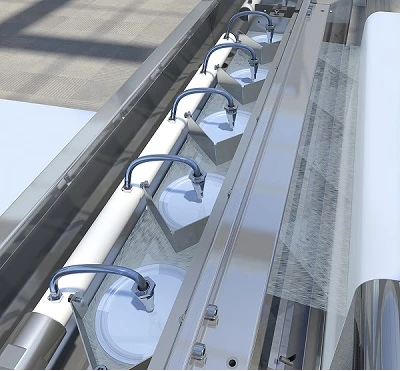 Rotor Carrier
6. Could you provide an overview of WEKO’s solutions specifically designed for corrugated board manufacturing processes?
Our coating systems are based on rotors that, through their rotation, enable a defined application of microdroplets. The microdroplets are propelled onto the surface of the paper web by centrifugal force. While they are larger than aerosols, no contamination from water or other chemicals occurs in the vicinity of the system. The rotors are arranged side-by-side in a rotor carrier and can easily accommodate all format widths with millimeter precision. The installation space required for these carriers is relatively small, making them suitable for both retrofitting and integration into new lines. Depending on the desired installation configuration, both vertical and horizontal webs can be moistened.
Specifically for large format widths, we offer rotor carriers with variable, zonally adjustable coating quantities. These quantities can be adjusted either manually or automatically via an interface to a moisture meter.
7. Moisture control and application precision are critical in corrugated production. How do your systems address these challenges effectively?
Each rotary carrier is supplied with a precisely calculated amount of liquid by a supply unit. The liquid volume is accurately measured and regulated by flow meters. The setting is digital and can be adjusted in 1/10 ml/m² increments. The supply system also precisely adapts the liquid volume to the web speed. This guarantees an accurate and repeatable liquid application.
8. What are the most common production inefficiencies or quality issues in corrugated board plants, and how does WEKO help overcome them?
The quality of corrugated board depends on many factors. A key factor is the paper used, which has a high proportion of recycled cellulose fibers. The quality of the fibers, additives, and the paper moisture content have a significant impact on production speed and dimensional stability. WEKO dampening systems spray a precisely adjustable amount of water onto the paper webs. This preparation makes the paper easier and more durable to forming, resulting in a stable flute. It also reduces the absorbency of the face sheets, leading to adhesive savings and dimension stability to eliminate curling effects. In summary, pre-moistening results in higher product quality, more stable production conditions while simultaneously saving on raw materials and waste output.
9. WEKO is known for its spray and application technologies. How do these technologies enhance productivity and product quality in corrugated board production?
By pre-moistening the paper, processes can be standardized. This improves flute stability and formation, minimizes glue usage, and extends the service life of die-cutting tools. The result is higher, trouble-free production speed and consistent product quality and stability.
10. Can you share how your solutions contribute to sustainability—particularly in terms of resource efficiency, waste reduction, or energy savings?
I admit that the main advantage of the WEKO liquid application system lies primarily in the improvement of product quality and production speed. Naturally, this also results in benefits such as energy savings and a reduction in waste material.
11. How customizable are WEKO systems for different plant setups or production scales in the corrugated industry?
The modular design of the application system allows for great flexibility in its use at a wide variety of installation positions. Liquid application can be performed independently on one or both sides. Variable format widths are virtually unlimited and can be adjusted with highest precision.
12. With increasing digitalization in manufacturing, how is WEKO integrating smart technologies or automation into its solutions?
The WEKO fluid application system can, of course, be integrated into an existing plant control system. Profinet and Profibus are available as communication protocols. Furthermore, a remote maintenance module can be integrated to provide fast and optimal plant support.
13. What trends do you foresee shaping the future of corrugated board production, and how is WEKO preparing to address them?
Sustainability, digitalization, automation, e-commerce, artificial intelligence – all big concepts that need to be put into practice.
I'm conservative in this and regard and focus on the sustainability and resource conservation of the raw materials used. Even today, the packaging industry uses an extremely high proportion of recycled materials. Compostable materials will certainly be added in the future. WEKO can help conditioning the raw materials and ensure that the material properties, and thus the production conditions, remain consistently good – simply by adding water in a defined way. That's what I call sustainable.
14. Finally, what message would you like to share with manufacturers looking to improve efficiency and quality in their corrugated board operations?
The quality of corrugated board products depends significantly on the raw paper used. The high recycled content, composition, and condition of the raw materials are not constant. WEKO can help to condition (moisten) the raw paper evenly and in a controlled manner. This stabilizes production conditions, optimizes process steps, and ultimately increases production speed and quality. A minimal amount of water – for a maximum effect.