Away-From-Home Towel Paper: Understanding Absorbency, Ply Structure and Performance Requirements for Commercial Hygiene
Towel paper may seem like one of the simplest products in a commercial facility, yet it has a direct effect on hygiene standards, washroom appearance, restocking frequency and waste volumes. The right choice depends on how three factors work together: the dispensing format, the ply structure and the absorbency of the sheet. This guide explains each of them in plain terms, so businesses can choose commercial towel paper that performs reliably under real-world traffic.
What is towel paper, and why does it matter in commercial hygiene?
Towel paper is a disposable, absorbent paper made for drying hands and wiping light spills in places people share: offices, hospitals, restaurants, schools, malls and transport hubs. It sits in the wider family of commercial tissue paper, but it is built differently from the bathroom tissue you buy for home. It has to stay strong when wet, absorb quickly and leave little lint behind.
That last part is easy to overlook. Drying hands properly matters because damp skin spreads bacteria more easily than dry skin, which is why industrial hygiene paper is treated as part of a washroom's hygiene system and not as a simple consumable. A towel that tears, sheds fibres or barely soaks up water pushes people to grab three or four sheets instead of one. That raises cost, fills bins faster and leaves a washroom looking neglected.
So the real question for any facility manager is not "which towel paper is cheapest per roll?" It is "which towel paper dries a pair of hands in the fewest sheets, without fuss, for the traffic we actually have?" Three things answer that: the dispensing format, the ply structure and the absorbency of the sheet.
What are the differences between hardwound and multifold paper towels for commercial use?
Both formats do the same job, but they behave very differently once they are inside a dispenser and a thousand people are pulling on them.
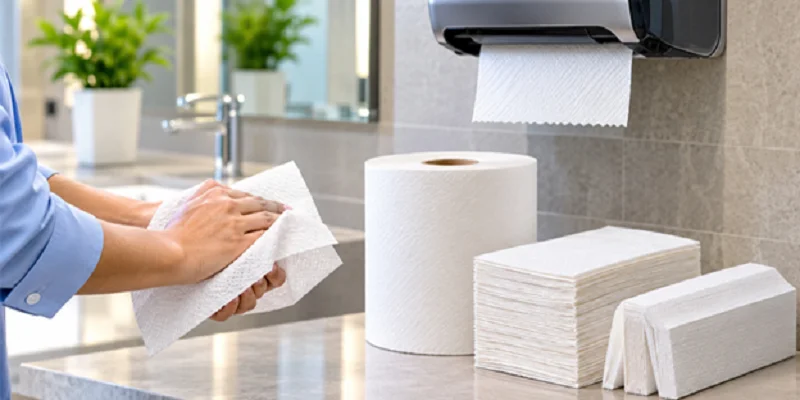
Hardwound paper towels come on a tightly wound roll and feed through a roll dispenser, either manual, lever-operated or touchless. Because there is no folding, one roll holds a lot of paper, so attendants refill less often. Many dispensers cut the sheet to a set length, which controls how much each person takes. That makes hardwound paper towels a natural fit for large washrooms, long opening hours and sites that want to reduce waste. The trade-off is the dispenser: it is usually bulkier and costs more than a simple fold cabinet.
Multifold paper towels are flat, interfolded sheets stacked in a slim dispenser. Each pull releases a single sheet, ready to use, in a shape such as C-fold, Z-fold or M-fold. There is no roll to thread and nothing to jam, and the dispenser is compact enough for narrow walls and small cubicle areas. Multifold paper towels suit offices, clinics, cafés and smaller washrooms where traffic is steady but not extreme. Their weak spot is capacity: a stack empties faster than a roll, and when people pull several sheets at once the supply can vanish quickly.
In short, hardwound is the better choice when you want fewer refills and tighter control over usage. Multifold is the better choice when you want simple, low-maintenance dispensing in a smaller space. Neither is automatically more hygienic; touchless operation and sheet-by-sheet dispensing matter more than the format itself. Many facilities end up using both, hardwound in the busiest blocks and multifold everywhere else.
How do ply structure and absorbency affect commercial towel paper performance?
Ply is the number of layers in a sheet. Most commercial towel paper is either one-ply or two-ply, and the difference is more than thickness.
One-ply sheets are a single layer, often with a bit of creping or embossing for texture. They are economical and work well in low-traffic areas or for light wiping, but a single layer reaches its limit quickly when hands are properly wet.
Two-ply sheets bond two thinner layers together, usually with embossing that locks them. The tiny air pockets between the layers hold water, so the sheet feels thicker, soaks more and resists tearing when pulled from a dispenser. For most washrooms, two-ply is where comfort and strength start to feel right.
But ply alone does not guarantee performance. Towel paper absorbency has two parts that people often confuse. Capacity is how much water a sheet can hold. Speed is how fast it picks that water up. A sheet with good capacity but slow uptake just smears water around, while a fast sheet with low capacity saturates after one wipe. Good commercial towels balance both, and they also keep wet strength, meaning the sheet does not break apart or leave lint once it is soaked.
Fibre choice and sheet structure drive these results. Virgin pulp tends to give a softer, stronger, cleaner sheet, while recycled fibre can be a sound, sustainable option when it is well processed. The way the paper is dried and embossed shapes how much air and water it can hold. That is why two towels with the same ply count and the same price can feel completely different in the hand.
The practical test is simple. If most visitors use two or three sheets to dry their hands, the towel is underperforming, whatever its specification says. A better sheet that people use once or twice usually costs less per wash than a cheaper sheet that gets used in handfuls.
What is TAD towel paper, and how do you choose it for high-traffic commercial washrooms?
TAD stands for through-air drying. In most conventional tissue-making, the wet paper web is pressed against a hot cylinder to squeeze out water, which compacts the fibres. In the TAD process, hot air is blown through the web instead, so the sheet dries without being flattened. The result is a bulkier, softer sheet with a textured structure that holds far more water between its fibres.
In practice, TAD towel paper tends to give three benefits:
- Higher absorbency per sheet, so one or two sheets usually dry both hands.
- A softer feel, which people notice and appreciate, especially in hotels, hospitals and premium offices.
- Good strength with low lint, even when the sheet is thoroughly wet.
These qualities matter most where traffic is heavy. In an airport, stadium, shopping centre or large hospital, a dispenser can be emptied several times a day. If each visitor takes fewer sheets, the roll lasts longer, bins fill more slowly and staff spend less time on restocking runs. Over a month, the saving in refills and waste handling can offset a higher price per roll.
Choosing TAD paper towels for high-traffic commercial washrooms comes down to a few checks. First, look at your real usage, such as visitors per day and sheets taken per visit, rather than the price on the carton. Second, confirm that the dispenser is compatible with the roll size and sheet length, because TAD rolls are often bulkier. Third, ask for samples and run a simple trial: dry hands with one sheet, then two, and see how the towel behaves when soaked. Finally, think about the washroom's image. Where comfort and impressions matter, a premium sheet supports the brand as well as the budget.
TAD is not always necessary. For a small office with a handful of users, a good two-ply multifold towel is often perfectly adequate. The premium option earns its place when volume, comfort and waste control all count.
How do you match towel paper to the washroom?
Start with the people, not the product. Count how many visitors a washroom sees on a normal day and on its busiest day. Then work backwards.
- Light traffic, small space: a two-ply multifold towel in a slim dispenser keeps things simple and tidy.
- Moderate to heavy traffic: hardwound rolls with a controlled-length dispenser cut refills and limit overuse.
- Very heavy traffic or premium settings: TAD towel paper on a hardwound system gives the best mix of absorbency, softness and fewer restocking trips.
Whatever you choose, check the details that quietly decide success: sheet size, roll length, dispenser fit, and how the paper feels when it is wet. Review the choice every few months, because a washroom that has grown busier may have outgrown the towel that suited it last year.
Frequently asked questions
Which is better for a busy washroom, hardwound or multifold paper towels?
Hardwound is usually better for busy washrooms because a single roll holds more paper and needs fewer refills. Multifold works well for smaller, quieter spaces.
Is two-ply towel paper worth it?
In most commercial settings, yes. Two-ply sheets absorb more, tear less and are typically used in smaller amounts per wash.
Does higher absorbency really reduce waste?
It can. When one sheet dries both hands, people stop pulling extra sheets, so rolls last longer and bins fill more slowly.
Is TAD towel paper only for premium facilities?
No. It suits any high-traffic site where absorbency, softness and low waste matter, from airports to hospitals. Smaller sites often do fine with standard two-ply towels.
How do I test towel paper before buying?
Request samples, dry wet hands with one sheet, then check strength, lint and how the sheet feels when soaked. Test it in your own dispenser too.
The best towel paper is the one nobody notices: it dries hands in a sheet or two, never jams and never runs out. Get the format, ply and absorbency right, and the washroom quietly looks after its visitors.
 Our Services
 Media Pack Download
 Newsletters
 Industrial Events