Sealing Difficult Flanges on Pulp-and-Paper Chemical Lines with Expanded PTFE
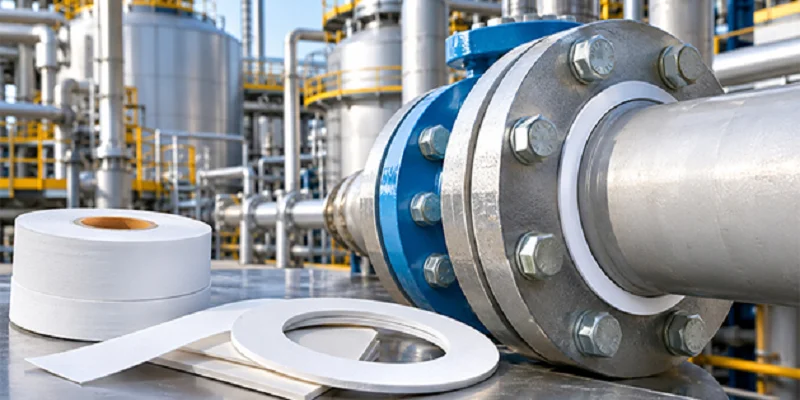
Pulp and paper mills expose flanged joints to demanding chemical and mechanical conditions. Bleaching, chemical preparation and recovery operations involve different fluids, including chlorine dioxide solutions, alkaline white liquor and spent cooking liquors. Depending on the service, equipment may be metallic, lined or made from fibre-reinforced plastic (FRP). Some joints combine irregular sealing faces with limits on allowable bolt load. Expanded polytetrafluoroethylene (ePTFE) is one material option for these situations, but its suitability depends on the specific fluid, gasket construction and joint design—not simply on the name PTFE.
Why chemical-line flanges are hard to seal
Chemical resistance is only the starting point. Chlorine dioxide is a strong oxidiser, while white liquor is strongly alkaline. Acid circuits and washing operations create other compatibility requirements. An elastomer that performs adequately on utility water may be unsuitable elsewhere in the mill. Assessment must consider the complete fluid composition, concentration, temperature and cleaning regime, rather than assuming that every gasket in a material family behaves identically.
Mechanical constraints are equally important. Glass-lined equipment can be damaged by excessive or uneven loading. FRP flanges may deform or suffer damage if assembly loads exceed the equipment limits. Conversely, insufficient gasket stress can leave leak paths. A suitable joint therefore needs a workable loading window: enough compression to seat and maintain the gasket, without exceeding the permissible loads of the flange, lining or fasteners.
Repeated opening, thermal cycling and corrosion can leave scratches, pits or distortion on sealing faces. Large manways and equipment covers also make uniform compression difficult to achieve. These conditions warrant inspection, not an automatic change to softer or thicker material. A gasket can accommodate only the surface deviations permitted for its application; it cannot restore structural integrity, correct piping misalignment or repair a damaged lining.
How expanded PTFE behaves
PTFE is widely used in chemical service because of its broad chemical resistance. Conventional virgin PTFE sheet can be appropriate for a correctly designed joint, but it is less conformable than many expanded grades. Under sustained compression, PTFE can also creep: deformation over time may reduce gasket thickness and retained bolt load. Both initial seating and longer-term load retention therefore matter when comparing candidate materials.
Expansion produces a fibrillated, microporous PTFE structure. This can provide a soft, compressible gasket that conforms to permitted surface irregularities. Expansion direction, density and construction influence mechanical behaviour, so ePTFE sheet, narrow sealant tape and composite gaskets should not be treated as interchangeable. Some grades are designed to improve dimensional stability and reduce creep relative to conventional virgin PTFE, but expansion does not eliminate relaxation or guarantee a seal at an arbitrarily low bolt load.
Broad chemical resistance is not universal compatibility. Obtain confirmation for the selected grade under the actual process conditions, including oxidizing service and any adhesive or other component that may be exposed. Published temperature and pressure limits are not independent permissions to operate at both extremes simultaneously. The permissible service envelope belongs to the complete joint and requires application-specific assessment; this overview provides no numerical design limits.
Sheet, joint sealant tape and rigid-core forms
Multidirectional ePTFE sheet can be cut into ring or full-face gaskets to match an approved drawing. It is convenient where joint dimensions are established and replacement gaskets can be stocked. The choice between ring and full-face geometry depends on the flange design and equipment instructions, not on a general preference. Gasket thickness also needs justification: extra thickness is not a substitute for correcting unacceptable face deviations.
Monodirectional ePTFE joint sealant is commonly supplied as a continuous, form-in-place tape. An adhesive backing, where supplied, helps position it during assembly rather than providing the pressure seal. Tape can simplify handling on large or non-standard sealing paths. Its width, thickness, placement and end-joint method must nevertheless be selected for the particular flange and product, with allowance for the material spreading as it is compressed.
Other constructions place soft sealing surfaces around a more rigid PTFE core. The purpose is to combine conformability with dimensional support. That construction may be worth evaluating for an approved lined-equipment application, but a core alone does not establish extrusion resistance or load requirements. The supplier needs to confirm the construction and its suitability; a generic description cannot replace grade-specific data and equipment approval.
Selection and installation practice
Before opening a joint, follow the mill’s approved isolation, lockout, depressurisation, draining and decontamination procedures. Verify that it is safe to work on and use personnel trained for the chemical hazards involved. The following considerations are maintenance review points, not a replacement for an authorised work instruction or an engineered bolting procedure.
Inspect both mating faces, alignment, fasteners and any lining. Remove old gasket residue using methods that will not damage the substrate. Chips, cracks, excessive waviness or a recessed lining require assessment against the equipment’s acceptance criteria. Repair or replacement may be necessary before gasket selection continues. Prepare clean, dry sealing surfaces as specified, and do not use bolt force to pull misaligned pipework together.
Confirm gasket dimensions and location against the drawing and installation instructions. The seal must remain on the intended sealing land after compression without obstructing the bore or interfering with fasteners. Use a new gasket rather than reusing one already compressed. For tape, avoid stretching during placement. Follow the manufacturer’s specified splice geometry and location: an approved overlap or skived joint for one product is not automatically correct for another. An improvised butt joint or a bulky, uneven overlap can compromise compression.
The target bolt load must satisfy the gasket’s seating and operating requirements while remaining within all equipment limits. Torque alone is an indirect means of applying load and depends on fastener condition and lubrication. Use the specified tightening sequence and staged passes, with suitable controlled tools. Do not transfer torque values from a steel flange to a glass-lined or FRP flange merely because the nominal size is the same.
Plan inspection and any permitted load recheck before returning the equipment to service. ePTFE may relax after assembly and thermal cycling, but retightening is not a universal instruction. It must be explicitly allowed by the equipment and gasket guidance and covered by the mill’s procedure. Any permitted retightening should take place only after safe isolation, depressurisation and cooling to the specified condition. Never tighten a leaking, pressurised chemical joint on the strength of this article.
Avoiding repeat failures
If a joint leaks, first make the system safe under the site procedure. Investigation should distinguish chemical attack, insufficient seating, relaxation, misalignment and unacceptable surface damage. Replacing the gasket with a softer grade without understanding the failure can reproduce the same problem. Record the selected material, dimensions, joint condition, assembly procedure and inspection findings so later maintenance decisions are based on traceable observations rather than assumptions.
Expanded PTFE can be a useful option for difficult pulp-and-paper chemical-line flanges when its construction and loading requirements match the service. The central discipline is to assess chemical compatibility, flange condition and the achievable loading window together. Careful selection and controlled maintenance—not a material label or an unsupported performance promise—provide the basis for evaluating whether a proposed gasket is appropriate for a particular joint.
 Our Services
 Media Pack Download
 Newsletters
 Industrial Events





Author Bio:

Alex Xu
Marketing Manager
Alex Xu is Marketing Manager at TEFLEX Fluorotec GROUP LIMITED, based in Cixi, Zhejiang, China. The company supplies PTFE and expanded PTFE sealing and filtration materials. His contribution here examines material selection and maintenance considerations for chemical-line flanges, with an emphasis on application-specific assessment rather than product promotion.