Paper Machine Components and Their Functions Explained
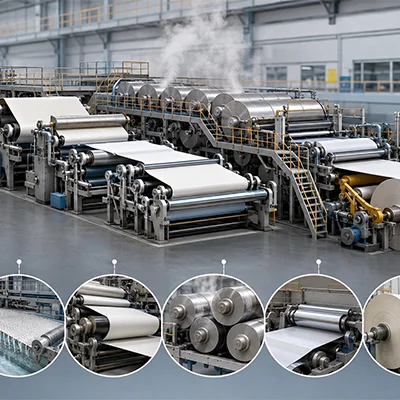
The paper manufacturing industry uses cutting edge equipment to convert the pulp slurry into several types of paper which are then used by the packaging industry, printing and publishing industry, tissue and other specialty applications. This process is based on the paper machine which extracts water from the pulp fibres, produces a uniform sheet, dries the pulp efficiently and prepares it for finishing and conversion.
The designer, the machine operator, the machine maintainers and the production managers of paper machines must understand the parts, their functions and operation to optimize the performance and product quality of the machines. Each section of the machine has a specific function to produce paper properties like strength, smoothness, thickness, moisture content and printability.
This article is a detailed explanation of the paper machine section wise for engineers which includes the major sections, key equipment and the working principle of the paper machine used in paper mill nowadays.
Understanding the Paper Machine Working Principle
It is important to understand the working principle of paper machine, before studying individual parts of paper machine.
It starts with a dilute pulp suspension, which consists of about 99% water and 1% fibres. This slurry is distributed uniformly onto a moving wire where water is drained. The formed sheet is then subjected to a succession of sections which extract further moisture from the sheet in a mechanical and thermal process before the paper is wound and sent for shipment.
The paper machine consists of the following steps:
- Stock preparation and delivery
- Sheet formation
- Water removal through pressing
- Thermal drying
- Surface treatment and finishing
- Reel winding
This continuous process can operate at speeds exceeding 1,500 meters per minute in modern industrial facilities.
Overview of Paper Machine Sections and Functions
A modern paper machine system typically consists of the following major sections:
- Headbox
- Forming Section
- Press Section
- Dryer Section
- Size Press or Coating Section
- Calendar Section
- Reel Section
- Drive and Control Systems
Each section contributes to transforming wet pulp into finished paper with specific quality characteristics.
1. Headbox – The Starting Point of Sheet Formation
The headbox is one of the most important paper machine components as it affects the quality of sheet formation.
Function
The headbox will spread the pulp evenly across the whole width of the machine and feed the stock into the forming fabric at a controlled flow rate and consistency.
Key Components
- Stock inlet system
- Flow spreaders
- Turbulence generators
- Slice opening
- Consistency control devices
Importance
A properly functioning headbox ensures:
- Uniform basis weight
- Even fiber distribution
- Reduced streaks and defects
- Improved sheet formation
Poor headbox performance can negatively affect paper quality throughout the production process.
2. Forming Section – Creating the Paper Sheet
The forming section is where the actual paper sheet begins to take shape.
Function
The primary purpose of this section is to remove water from the pulp suspension while retaining fibers and fillers to create a continuous paper web.
Main Paper Machine Parts in the Forming Section
Forming Fabric (Wire)
The forming fabric is a continuously moving mesh that supports the pulp slurry while allowing water to drain.
Breast Roll
Located at the beginning of the forming section, the breast roll supports the wire and helps guide it.
Foils and Drainage Elements
These components create pressure pulses that assist water removal.
Suction Boxes
Vacuum-assisted devices remove large amounts of water from the sheet.
Couch Roll
The couch roll performs the final dewatering stage before the sheet enters the press section.
Moisture Reduction
During formation:
- Stock enters at approximately 99% water
- Water content is reduced significantly
- Fiber mat formation begins
This stage largely determines sheet uniformity and formation quality.
3. Press Section – Mechanical Water Removal
After leaving the forming section, the paper web remains extremely wet and fragile. The press section removes additional water using mechanical pressure.
Function
Press section removes water from web and increases the bond and strength of the fibers.
Major Components
Press Rolls
Heavy rolls apply pressure to the paper sheet.
Press Felts
Special fabrics absorb water removed during pressing.
Suction Press Rolls
These rolls combine pressure and vacuum to improve water extraction.
Shoe Press
Modern machines often use shoe presses that provide extended nip residence time for greater dewatering efficiency.
Benefits
Effective pressing offers several advantages:
- Reduced dryer energy consumption
- Improved sheet strength
- Better machine efficiency
- Lower operating costs
Typically, sheet dryness increases from approximately 20% to 45–50% after the press section.
4. Dryer Section – Thermal Moisture Removal
The dryer section is often the largest part of a paper machine and consumes significant energy.
Function
Its primary role is to evaporate the remaining water from the paper web using heated cylinders.
Main Components
Dryer Cylinders
Large steam-heated cylinders transfer heat to the paper.
Dryer Fabrics
These fabrics hold the sheet against dryer cylinders for efficient heat transfer.
Steam and Condensate System
This system supplies steam and removes condensate from dryer cylinders.
Ventilation System
Moisture in the drying process is carried away by ventilation.
Drying Process
The sheet travels through multiple groups of dryer cylinders.
As it progresses:
- Moisture continues to decrease
- Sheet strength increases
- Paper dimensions become more stable
Final moisture content is usually maintained between 4% and 8%, depending on the paper grade.
5. Size Press and Coating Section
Many paper grades require enhanced surface properties before reaching the finishing stage.
Function
The size press applies starch solutions or other additives to improve paper characteristics.
Key Components
Applicator Rolls
These rolls transfer sizing solution onto the paper surface.
Metering Systems
They control coating thickness and application consistency.
Drying Equipment
Additional dryers remove moisture introduced during sizing or coating.
Benefits
Size press treatment improves:
- Surface strength
- Printability
- Ink holdout
- Water resistance
- Smoothness
For coated papers, specialized coating stations may be installed to achieve premium surface quality.
6. Calendar Section – Surface Finishing
The calendar section enhances the paper's surface characteristics.
Function
It improves smoothness, gloss, thickness uniformity, and overall appearance.
Main Components
Hard Rolls
Steel rolls provide compressive force.
Soft Rolls
Polymer-covered rolls create controlled pressure distribution.
Nip Control System
Maintains desired pressure between rolls.
Results
Calendaring helps achieve:
- Better print quality
- Uniform thickness
- Improved surface finish
- Enhanced visual appearance
The degree of calendaring depends on product requirements and customer specifications.
7. Reel Section – Winding Finished Paper
The reel section represents the final stage of the papermaking process.
Function
The reel winds the finished paper web into large rolls for storage, transportation, or conversion.
Key Components
Reel Drum
Supports paper winding.
Spool
Collects the finished paper roll.
Tension Control System
Maintains consistent winding quality.
Importance
Proper winding prevents:
- Wrinkles
- Roll defects
- Edge damage
- Web breaks during conversion
The completed rolls are then sent to rewinding, slitting, sheeting, or packaging operations.
Supporting Paper Machine Systems
Beyond the major production sections, several auxiliary systems are essential for efficient machine operation.
Vacuum System
Supports water removal in forming and press sections.
Lubrication System
Ensures reliable operation of bearings and rotating equipment.
Steam and Condensate System
Provides thermal energy for drying.
Drive System
Controls machine speed and synchronization.
Automation and Control System
Modern machines use advanced automation for:
- Basis weight control
- Moisture control
- Thickness monitoring
- Quality assurance
- Process optimization
These systems are essential for maintaining production efficacy and product steadiness.
Paper Machine Diagram Explanation
A simplified paper machine elucidation follows the flow of paper production from left to right:
Stock Preparation → Headbox → Forming Section → Press Section → Dryer Section → Size Press/Coating → Calendar → Reel
Each stage progressively removes water and improves sheet properties.
Water Content through the Machine
| Section | Approximate Water Content |
| Headbox | 99% |
| Forming Section Exit | 80% |
| Press Section Exit | 50–55% |
| Dryer Section Exit | 4–8% |
| Reel | Finished Product |
This illustrates how the machine gradually transforms dilute pulp into finished paper.
How Does a Paper Machine Work Step by Step in Industry?
Many engineers entering the paper industry ask: How does a paper machine work step by step in industry?
The process is as follows:
Step 1: Pulp Preparation
Stock is a combination of fibers, water and additives.
Step 2: Stock Delivery
The stock is pumped to the headbox.
Step 3: Sheet Formation
The headbox distributes stock onto the forming fabric.
Step 4: Initial Dewatering
The vacuum elements and the wire are used to allow the water to pass through.
Step 5: Pressing
Water is extracted further by mechanical pressure.
Step 6: Drying
All moisture is removed by steam heated cylinders.
Step 7: Surface Treatment
Sizing or coating improves paper properties.
Step 8: Calendaring
The sheet surface is smoothed and finished.
Step 9: Reeling
Paper is rolled up into big rolls.
Step 10: Conversion and Packaging
The finished rolls are sliced, wrapped, packaged and delivered to the customers.
Knowing the components of a paper machine is important
Good understanding of paper machine sections and functions is essential for productivity, troubleshooting process problems and product quality assurance.
Engineers who understand individual paper machine components can:
- Diagnose machine performance problems faster
- Improve energy efficiency
- Reduce downtime
- Enhance paper quality
- Optimize production output
- Extend equipment life
While paper machines are becoming increasingly automated, sophisticated sensor and digital monitoring systems, it is important to understand the basics of machine operations to ensure successful mill operation.
Conclusion
A modern paper machine system is a much integrated system that converts dilute pulp slurry, into high quality paper, through a series of well-controlled operations. The parts of the paper machine are each involved in a specific process that is used to get the desired paper properties in the final product from the headbox to the forming section, to the pressing, drying, calendaring and winding.
The knowledge of how the paper machine works, in addition to a thorough knowledge of paper machine components, helps engineers and production teams to optimize the machine, maintain product quality and consistency, and aid in ongoing improvement efforts. Each of these machine sections is crucial to any successful papermaking operation, whether in the production of packaging paper, printing grades, tissue products or specialty papers.
 Our Services
 Media Pack Download
 Newsletters
 Industrial Events