Paper Finishing and Coating Techniques for Print Quality
Introduction: Why Paper Finishing Defines Print Excellence
The choice of substrate in the commercial printing ecosystem can be described as the beginning of the whole process. Real separation between print quality, durability, and brand perception is in types of paper finishing and coating technologies. In the case of B2B purchasers - be it packaging, publishing, marketing message, or corporate branding, color vividness, tactile reaction, durability, and overall ROI is directly related to the type of coated printing paper and finishing process.
The printing paper finishes, whether it is the marketing brochures and annual reports, product catalogs and the luxury packaging inserts, determine how the ink reacts to the surface, the way light reflectively behaves and how the finished product will perform in actual handling. Knowledge of matte and glossy paper and the types of coated paper to use in printing is quite crucial in the procurement management, print buyers and brand custodians who require uniform and quality production.
This article discusses various printing paper finishes, coating methods, performance aspect and strategic decision making model of choosing the most appropriate paper finish to use in high quality printing.
Understanding Paper Finishing in Commercial Printing
Paper finishing is the activity that involves the after-manufacturing process, which improves the performance, appearance, and surface properties of paper. These might include coating, calendering, laminating, varnishing or specialty.
When using B2B printing, the finishes of printing paper are chosen due to the purposes of application, brand image, compatibility of inks, and efficiency. An example is that a high-end fashion motivational can be made using glossy paper to add the pictures and a corporate report on sustainability would be more inclined to use matte paper to be able to read it and look more professional.
Paper finishing can be divided into more general segments of surface texture treatments and coating applications. The two control print sharpness, drying time, ink absorption, and touch.
Types of Paper Finishes in the Printing Industry
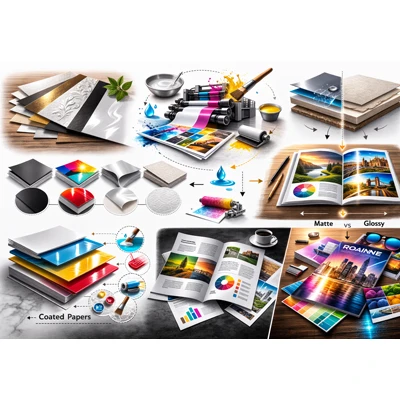
The knowledge of paper finishes types is a basic part of achieving the best results in print. The most widespread types of finishes are gloss, matte, silk (satin) and uncoated.
Gloss finish gives a very reflective surface which increases the colour saturation and the contrast of images. It is widely employed in any marketing material where one needs the visual impression.
Matte finish provides a non-reflective surface that is smooth and which minimises glare and enhances the reading of text. It has a sleek and business-like look.
Silk or satin finish is placed between matte and gloss and has a moderate reflectivity but more smoothness.
Uncoated finishes would offer a natural feel, choose more ink to absorb, and could be softer; this is done on stationery and branding decisions that are eco-friendly.
All these various printing paper finishes have specific functional and branding applications in the B2B applications.
Coated Paper for Printing: Composition and Function
Printing on coated paper is produced by a surface coating of mineral or polymer-based coating to enhance smoothness, brightness and holdout of ink. This coating layer suppresses excess ink uptake and the images are sharper and the colors are reproduced better.
Clay, calcium carbonate, and latex binders are the most widespread types of coating materials. Such materials fill the irregularities on the surface forming a uniform print surface that is optimal in giving high-resolution output.
The forms of printing on coated paper are normally categorized by the degree of finish and the intensity of coating. These are high gloss coated stock, matte coated stock as well as silk coated. All are designed to address commercial needs.
Coated printing paper is used in large-scale printers where there are high levels of offset and digital printing to achieve high consistency in print runs thereby minimizing waste and promoting printing efficiency.
Glossy Paper Coating: Enhancing Visual Impact
Shiny paper lamination is meant to increase light reflection and color intensity. The smooth texture reduces the number of ink penetration, rendering the pigments to stay on the surface of the sheet producing sharp and saturated images.
The retail industry, auto industry, luxury goods and travel are some of the industries where brochures, product catalogs and promotional flyers are often done using glossy finishes. In brochure cases, glossy paper usually prevails over matte since a brochure is image-based and the product photography is the most dominant force to make it appealing.
Slick finishes, however, can produce glare in bright light conditions, and this can have an impact on legibility. In the case of trade show materials and point-of-sale displays, the lighting conditions have to be kept in mind when choosing gloss.
Cost wise, glossy finishes can cause the production cost to go a bit higher but provide greater perceived value when used in a visual campaign.
Matte vs Glossy Paper: A Strategic Comparison
The argument concerning matte vs glossy paper is not only aesthetic, but it is also operational, and brand-based.
The matte and glossy paper are distinguished by mainly reflectivity, the textures and the interaction of ink. Glossy surfaces are more reflective of light and provide more color contrast whereas the matte surfaces reflect a lot less and have less glare.
The matte finishes would be best used in documents with lots of text, company reports, school materials, and high-end brand storytelling works. Images with vibrant content, promotional brochures and visual merchandising materials are preferred in glossy finishes.
In comparing glossy and matte paper in brochures, B2B decision-makers are advised to look at target audience expectation, distribution, and the lighting conditions.
An example is a luxury real-estate brochure which would be better printed on a silk or matte finish to convey the sense of exclusivity, and a consumer electronics brochure would need a glossy coating on the paper to highlight the visual content of the product being advertised.
Types of Coated Paper for Printing in Industrial Applications
Commercial print houses generally divide the coated printing paper into categories according to the coating weight and the surface finish.
Coated paper of light weight is commonly applied in magazines and in high volume publishing where the economy is very important. Premium catalogs and company marketing projects that need durability make use of heavyweight coated stock.
The paper with high-gloss is made to be photographed. Matted coated stock is intended to be readable and less glare producing. Silk coated stock balances between the attributes.
They all have effects on drying time, ink adhesion and compatibility in finishing. When in high-speed production settings, the right choice of coated paper to be used in printing will result in maximum presses and reduced time wastage.
Surface Finishing Techniques Beyond Coating
In addition to ordinary coating, there are high-tech methods of finishing that make finishes more durable and beautiful.
Calendaring is a mechanic finishing, which is a procedure that involves the smoothing of paper by applying pressure rollers. It enhances the surface uniformity with no coating layers.
Lamination is a process that entails attaching a layer of plastic over the paper. It enhances strength, waterproofness and feel.
UV coating is the application of a liquid coating that hardens in ultra-violet light producing a high gloss or spot-gloss effect. This is a technique that has found a following among high-end marketing collateral.
Aqueous coating, a water-based layer, is used to increase the durability of the product and allow it to be recycled.
These are the other finishing procedures which are usually applied on top of the coated printing paper to give particular brand effects.
Selecting the Best Paper Finish for High Quality Printing
To decide on the best paper finish to use to print high quality papers, it is necessary to consider several operational and branding issues.
Selection is affected by print resolution requirements, ink technology, target audience and distribution environment.
The digital presses can be made to act differently than the offset press which means that they require custom substrate selections.
In cases where visual elements are important and it is necessary to use high-end marketing materials, glossy paper coating could be better. Matte finishes may be a superior choice in corporate communications that are more concerned with readability.
Budget factors are also important. Although premium coated stocks help to raise perception, cost-benefit analysis should correspond with the objectives and volume of the campaign.
Print buyers are also expected to be closely working with the suppliers to ensure that they are able to test various finishes in printing paper before mass production.
Industry-Specific Applications of Paper Finishing
The informational brochures in the pharmaceutical industry are usually done in matte finishes as they are readable and because of documentation requirements to comply with.
Soft-touch laminated finishes or silk are some alternatives that luxury brands would like to employ in order to improve the touch feel.
FMCG and retail brands usually use slick finishes in the style of a catalog and promotion inserts to make the maximum visual appeal.
Publisher of educational materials tend to use matte coated printing paper in printing textbooks in order to minimize eye strain.
Knowledge of industry context will make sure that the kind of paper finishes is used in making sure that the functional expectations and brand identity are in line.
Operational Considerations for Commercial Printers
Production In the production perspective, coated paper to be used in printing influences the use of ink, time to dry and press calibration.
Glossy surfaces have to be very accurate in ink use to avoid smudging. Light absorption may necessitate a slightly large amount of ink to be applied to matte surfaces.
There is also a difference in warehousing and handling. Smooth surfaces are also more prone to the visibility of the fingerprint, and matte finishes might have different scuff marks.
Another factor that is increasing is sustainability. Corporate buyers are showing rising preference to environmentally responsible finishes and recyclable substances.
FAQ Summary: Key Decision Questions
What is the primary difference between matte and glossy paper?
The distinction between the glossy and the fine paper lies on the differences in their reflective and reflective intensity of the pictorials. When gloss is applied and glare reduced by the application of matte, the color is very bright.
Which is better for brochures: glossy vs. matte paper for brochures?
The decision is based on design focus. Promotional brochures that are image-intensive are smooth and corporate and those that are text-intensive are usually matte.
What are the main types of coated paper for printing?
They are gloss coated, matte coated, silk coated and depending on the coating weight and brightness.
How do paper finishing types impact cost?
State-of-the-art coating and laminations escalate the cost of production but boost durability and value.
The Future of Paper Finishing and Coating Technologies
With the development of digital printing, the technologies of coatings are developing correspondingly, to enhance the compatibility of inks, sustainability, and efficiency. Nano-coatings, biodegradable surface treatments and improved gloss control systems are innovations that are forthcoming.
Combination of matte and spot-gloss finishes is becoming popular in high-end branding.
Finishing lines are also getting automated which enhances standardization and minimizes wastes especially in the high volume B2B print process.
Differentiation by using advanced printing paper finishes has been a competitive strength in a very competitive print market.
Conclusion: Aligning Finish with Brand and Performance Goals
Finishing and coating of paper is not simply a form of aesthetics, but a strategic device that determines the brand perception, longevity, performance, and the customer interaction.
Knowledge of types of paper finishing, coating of the paper to use in printing and trade-offs between matte and glossy paper will help in making informed choices in the procurement of the paper. It does not matter whether one is choosing slick paper coating on vibrant marketing pieces or matte coated stock on business communications, the desired objective is the same to produce high-quality print that meets the corporate goals.
When it comes to B2B printing, success is determined by the ability to match the correct finish with the correct application. With the aid of the latest technology of coating and a thorough evaluation of various finishes of printing papers, organizations can attain the visual and functional excellence in each print project.
 Our Services
 Media Pack Download
 Newsletters
 Industrial Events