Folder Gluer Machines: How Folding and Gluing Build Paper Packaging
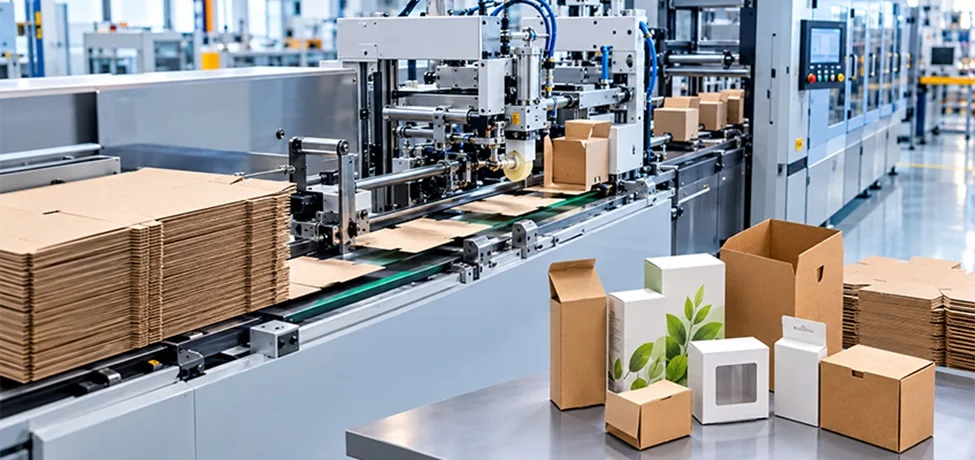
Every day, millions of cartons leave factories as flat, printed sheets and arrive on store shelves as sturdy, perfectly squared boxes. Most people never wonder how that happens. The answer is a folder gluer machine, the quiet workhorse of paper packaging.
Whether you're curious how a simple medicine box gets its crisp folds, or you're comparing equipment for your own carton plant, this guide explains it in plain language: what happens inside the machine, why it matters and what to look for before you invest.
What Is a Folder Gluer Machine? (Quick Answer)
A folder gluer machine is industrial equipment that takes flat, die-cut paperboard or corrugated blanks, folds them along pre-creased lines, applies glue to a seam or flap, and presses it closed so the blank becomes a flat-collapsed carton. The carton ships flat and is opened up later on the filling line.
You'll hear the same equipment called a folding and gluing machine, a paper gluing machine, a carton folding machine or simply a paper folding machine. In practice, these terms overlap heavily. What matters is the job: fold accurately, glue reliably, deliver consistently.
Why Folding and Gluing Matter More Than You'd Think
Printing gets the attention. Folding and gluing decide whether the box actually works.
A carton with a crooked fold won't erect properly on a packing line. A weak glue seam pops open in a warehouse in July. A box with misaligned flaps looks cheap on the shelf, however beautiful the print is. Converters know this well: the folder gluer is where profit is either protected or quietly lost to rework and rejects.
How Folder Gluer Machines Work: Step by Step
Here's the journey of a single blank through an automatic folder gluer.
1. Feeding. A stack of die-cut blanks sits in the feeder. Belts or a feeding head pull them out one at a time, at a steady, controlled pace. Consistent spacing here prevents jams later.
2. Pre-breaking. Many machines pre-fold the creases slightly (usually the first and third panels) so the carton "remembers" where to bend. This is especially helpful for stiff board.
3. Alignment. Side guides and registration systems square each blank so folds land exactly on the crease lines.
4. Gluing. Glue is applied to the designated flap. Cold glue (water-based), hot melt or a combination may be used depending on the board, coating and speed. Nozzles or wheels place it precisely, and many systems monitor it with sensors.
5. Folding. Folding belts and hooks (or rods and plows) carry the panels over, guide them around the crease and bring them together. Smooth folding avoids cracking at the score.
6. Pressing and compression. The glued seam passes through a pressure section so the bond sets properly while the carton moves along.
7. Counting and delivery. The finished flat cartons are stacked or kicked into batches, then bundled for the next stage.
All of this happens at speeds that can reach hundreds of meters per minute on high-end machines, which is why stability matters as much as raw speed.
Main Parts of a Folding and Gluing Machine
Knowing the sections helps you diagnose problems, compare quotes and train operators.
- Feeder section: Handles blank separation and entry. A good feeder is the difference between a smooth shift and constant stoppages.
- Pre-folder / pre-breaker: Prepares creases for easy folding.
- Gluing unit: Applies adhesive with accuracy. Look for easy access and quick cleaning.
- Folding section: Where the box takes shape through belts, hooks and plows.
- Transfer and pressing section: Compresses the glued seam.
- Delivery and counter-ejector: Counts, batches and stacks the output.
- Control system: Modern machines use touchscreen controls and saved job recipes to cut changeover time.
Types of Paper Folding Equipment
Not every operation needs the same machine. Here's a simple comparison.
|
Type |
Best For |
Typical Strength |
Typical Limit |
|
Semi-automatic folding and gluing machine |
Small shops, short runs |
Low investment, simple operation |
Lower speed, more operator input |
|
Automatic folder gluer (straight-line) |
Standard cartons, medium to high volumes |
Speed and consistency |
Limited to simpler styles |
|
Automatic folder gluer (crash-lock bottom) |
Cartons that erect by hand or machine |
Handles complex bottoms |
Needs careful setup |
|
Multi-point / 4-6 corner folder gluer |
Trays, gift boxes, specialty cartons |
Versatile for premium packaging |
Higher cost, more skill needed |
|
Corrugated folder gluer |
Shipping boxes, e-commerce packaging |
Handles thick, rigid board |
Different build from paperboard units |
The right fit depends on your board type, carton styles, order sizes and how often you switch jobs.
What Can These Machines Produce?
Quite a lot. Typical outputs from folder gluer machinery for paper packaging include:
- Straight-line cartons (food, cosmetics, pharma)
- Crash-lock (auto-bottom) cartons
- 4- and 6-corner boxes and trays
- Sleeves and wraparound cartons
- Window cartons (with film patching)
- Corrugated shipping and mailer boxes
Many plants run a mix, which is why quick changeovers are a bigger selling point than top speed.
How to Choose an Automatic Folding and Gluing Machine for Carton Production
Here's the part most buyers wish they'd thought about sooner. Before you compare brands, answer these questions.
1. What are you making?
List your carton styles, board thickness range and minimum and maximum sizes. A machine that can't handle your smallest or largest job is the wrong machine, regardless of the price.
2. How long are your runs?
Short, frequent jobs call for fast setup and stored recipes. Long runs reward raw speed and uptime.
3. How skilled is your team?
A sophisticated machine in untrained hands underperforms a simpler one run well. Factor in training and support.
4. What glue do you need?
Coated stocks, laminated board and food-contact packaging may need specific adhesives and application methods.
5. Is there inspection built in?
Camera-based inspection for glue presence and fold quality catches defects before they reach a customer.
6. What does after-sales support look like?
Spare parts availability, response time and local service often matter more over five years than the original price.
7. What's the total cost of ownership?
Count energy, spares, downtime, waste and operator hours, not just the invoice.
Common Problems (and Quick Fixes)
Even a good machine misbehaves sometimes. Here are the usual suspects.
- Cracking at the fold: Check board grain direction, crease depth and pre-breaking settings.
- Weak or failed glue seams: Review glue type, application amount, pressure and open time. Dust or coating on the glue area is a frequent culprit.
- Skewed cartons: Inspect belt wear, alignment and feed consistency.
- Frequent jams at the feeder: Look at blank condition, stack quality and feeder timing.
- Glue squeeze-out: Reduce the glue amount or adjust the pressing section.
A simple preventive routine (cleaning nozzles, checking belts, logging settings per job) prevents most of these.
Tips to Get More From Your Folder Gluer
- Standardize job recipes. Save settings so repeat jobs start fast and consistent.
- Train for changeovers. Shaving fifteen minutes off every setup adds up to days over a year.
- Keep blanks well stored. Humidity changes board behavior, which affects folding.
- Plan maintenance, don't wait for breakdowns. Belts, nozzles and sensors have predictable lifespans.
- Talk to your die-cutter and printer. Many folding problems start upstream.
Where Is Folder Gluer Technology Heading?
Expect more automation: servo-driven adjustments, camera inspection as standard, remote diagnostics and smarter setup that reduces operator guesswork. As brands demand shorter runs and more variety, machines that switch jobs quickly will keep pulling ahead of machines that only run fast.
Frequently Asked Questions
What does a folder gluer machine do?
It folds pre-scored paperboard or corrugated blanks and glues them into flat-collapsed cartons, ready to be erected and filled later.
What's the difference between a folder gluer and a paper gluing machine?
A paper gluing machine only applies adhesive. A folder gluer does both: it folds and glues in one continuous pass.
How fast is an automatic folder gluer?
Speeds vary widely by model, carton and board. Industrial machines can run at several hundred meters per minute, but real-world output depends on setup, glue and material.
Can one machine handle different carton styles?
Yes, within limits. Straight-line, crash-lock and multi-corner styles often require different configurations or accessories, so confirm your range before buying.
What glue is used in folding and gluing machines?
Commonly cold (water-based) glue or hot melt, chosen by board type, coating, speed and application.
How do I reduce rejects on a folder gluer?
Control the basics: clean glue systems, correct pressure, consistent blanks, good alignment and documented job settings.
Is a semi-automatic folding machine ever the better choice?
Absolutely. For small businesses with short runs and limited budgets, a semi-automatic paper folding machine can be the smarter first step.
The Bottom Line
A folder gluer machine quietly turns flat paper into the packaging we handle every day. Understanding how folding and gluing work, what each section does and how to match the machine to your actual jobs helps you buy smarter, run steadier and waste less.
Whether you're comparing an automatic folder gluer for a growing carton business or just curious how that box got made, the principle is the same: great packaging is built on accurate folds and strong seams.
Looking for the right folding and gluing machine for your production? Share your carton types, board range and monthly volume with your equipment supplier, and ask for a trial on your own material before you commit.
 Our Services
 Media Pack Download
 Newsletters
 Industrial Events