Fiber Partitions for Industrial Packaging: Design, Material Selection and Product Protection During Transportation
Returned shipments tend to show the same failures. Glass bottles arrive with chipped necks. Automotive parts show scuffing where surfaces rubbed together. Electronic components come back with bent pins. In each case, the product left the factory in good condition and was damaged in transit.
The outer carton is rarely to blame. The more common cause is a lack of separation inside it. When products touch during shipping, vibration and impact turn that contact into abrasion, collision, and crushing, often well before the carton itself fails.
Fiber partitions address this directly. They give each item a fixed position, limit movement, and keep neighboring products from making contact. This makes them one of the most underrated elements of protective packaging, and one of the most cost-effective ways to reduce transit damage and returns.
What are fiber partitions?
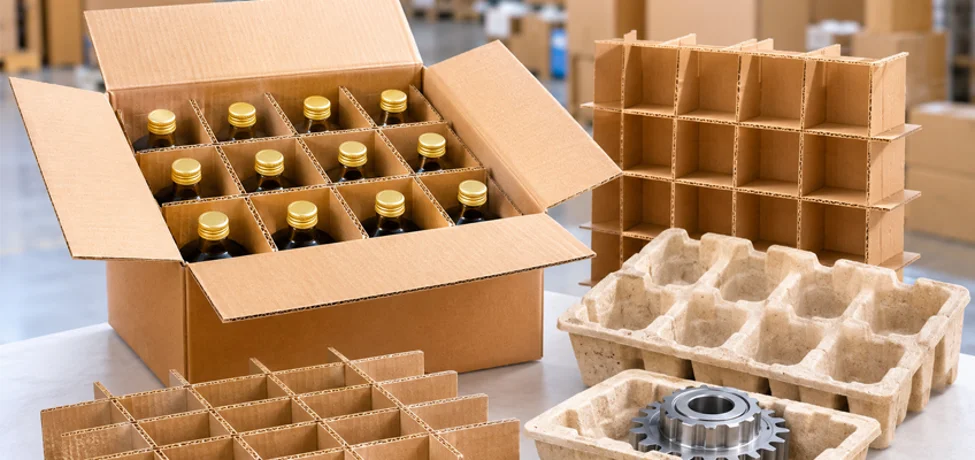
Fiber partitions are paper-based dividers placed inside a carton to hold products apart, keep them in position and absorb shock during handling and transport. They’re also called paper partitions or packaging partitions, and they’re made from recycled or virgin paper fiber.
They usually come in two forms:
- Corrugated partitions: flat strips of fluted board that slot together in a grid (the egg-crate style) inside a box.
- Molded fiber packaging: pulp pressed into shaped trays, cups or cradles that fit a product’s contour.
Both fall under the wider category of product separation inserts. Both exist to stop one thing: product touching product.
How fiber partitions protect products during industrial transportation
A shipment doesn’t travel gently. Between the warehouse and the customer, a carton gets stacked, dropped, tilted, vibrated for hours on a truck and squeezed under other pallets. Fiber partitions handle that in four ways.
- They stop product-to-product contact. Glass, ceramics, painted metal and polished surfaces get damaged mostly by rubbing and collision. A partition puts a physical wall between each item, so one bump doesn’t pass from item to item.
- They absorb and spread shock. Paper fiber compresses slightly under impact. That small give turns a sharp hit into a slower, softer one, so less force reaches the product.
- They lock products in place. A bottle that can’t shift can’t build momentum. Snug cells keep products fixed even when the carton is tipped or jolted.
- They share the stacking load. Corrugated partitions work as vertical columns inside the box. They help the carton resist crushing when pallets are stacked high, and they stop the box from caving in on its contents.
Think of it this way: the outer carton protects against the outside world, and the partition protects products from each other. You need both.
Differences between fiber partitions and corrugated packaging inserts
This is one of the most common questions buyers ask, and it’s confusing because the terms overlap. Corrugated partitions are a type of fiber partition. The real comparison is between molded fiber and corrugated construction, and between partitions and other kinds of inserts, such as pads, sheets and foam.
Here’s a quick way to compare them:
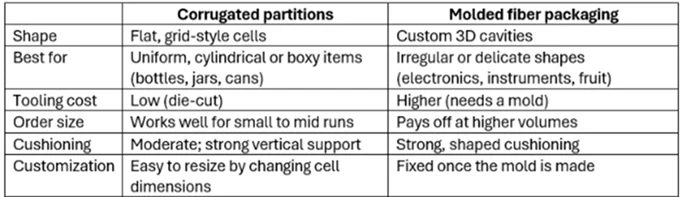
Corrugated inserts such as pads, sheets and layer dividers do a different job. They separate whole layers of products, but they don’t isolate each item. If your products are fragile enough to be hurt by a neighbor, a layer divider alone won’t be enough.
Short answer: pick corrugated partitions when your products are regular in shape and you want flexibility and low cost. Pick molded fiber when the product has an awkward shape or needs a cradle fit.
Fiber vs. plastic and foam: why paper-based keeps winning
Plastic trays and foam inserts still have their place. But paper-based partitions are gaining ground for practical reasons, not just good intentions.
- Sustainability: fiber is recyclable and often made from recycled content. For brands answering to retailers, regulators or customers who ask about packaging waste, that matters.
- Cost: standard corrugated partitions are inexpensive, and they ship flat, which saves warehouse space.
- Disposal: the customer or warehouse can recycle them with ordinary cardboard, with no sorting needed.
- Compliance: some markets are tightening rules on single-use plastic, which makes paper-based packaging a safer long-term choice.
Foam still wins where you need very high, repeatable cushioning for extremely delicate goods. For a large share of industrial products, though, a well-designed partition does the job.
Design: where most partition failures begin
A partition can be made of excellent board and still fail if it’s designed badly. These are the design points that matter most.
Fit is everything. Too loose and the product rattles. Too tight and you risk scuffing, and packing becomes slow. Aim for a snug fit with a small tolerance for packing speed and natural variation in product size.
Cell height matters. Partitions should come high enough up the product to stop sideways movement, but not so high that they block packing or waste material. For tall items like bottles, partition height relative to product height is a key part of the design.
Match the partition to the carton. The partition should sit flush with the carton’s internal dimensions. Even a few millimeters of slack lets the whole grid shift in transit.
Think about the packing line. A partition that protects perfectly but takes 40 seconds to load will be skipped or misused. Good design is also about how people actually pack.
Account for weight. A heavy product such as a metal part or a filled glass jar needs a stronger board and thicker walls than a light plastic item.
Material selection: choosing paper-based partitions for protective industrial packaging
This is where the buying decision gets real. If you’re choosing paper-based partitions for protective industrial packaging, work through these questions in order.
What are you shipping, and how fragile is it?
Weight, shape and surface finish drive everything else. A polished component and a sealed steel drum need very different protection.
What’s the board grade?
Corrugated partitions come in different flute profiles and board strengths. Thicker, stronger board handles heavier loads and stacking. Thinner board is fine for light products and saves cost. Ask your supplier for the board’s burst or compression strength, not just a thickness.
Will it face moisture?
Paper weakens when it’s wet. If your shipment goes through humid ports, cold storage or long sea transit, ask about moisture-resistant coatings or treatments. This is the most common hidden failure point.
Will it touch the product directly?
For sensitive finishes, food-adjacent products or electronics, you may need cleaner, lint-free or specially treated grades.
How will it be shipped and stacked?
Pallet stacking height, transit mode (road, rail, sea or air) and distance all change how much strength you need. A short domestic trip and a three-week export journey are different tests.
What’s your volume?
Low or changing volumes favor die-cut corrugated. High, steady volumes of one product justify the tooling cost of molded fiber.
Common mistakes to avoid
A few errors show up again and again.
- Designing for the product, not the journey. A partition that works on a packing table can fail on a vibrating truck. Test under real transport conditions.
- Choosing on price per unit alone. A cheaper partition that lets 2% of products break costs more than a better one.
- Ignoring the carton. The partition and the box work as a system. Upgrade one and neglect the other, and the weak link still fails.
- Skipping a pilot run. Always run a small trial shipment before committing to a full order.
A simple way to test your packaging
Before you scale up, do a basic check: pack a sample carton, drop it from a realistic handling height onto its corners, edges and flat face, then shake it hard or run it through a vibration test if you have access. Open it and look. Are products touching? Has the grid shifted? Is any board crushed? Those few minutes can save you thousands in damage claims. Many packaging suppliers will also run formal transit tests if you ask.
Frequently asked questions
What are fiber partitions used for?
They separate and cushion products inside cartons, mainly in industries like glass and bottling, automotive, electronics, pharmaceuticals and food and beverage.
Are paper partitions strong enough for heavy products?
Yes, if the board grade and cell design are matched to the load. For very heavy items, heavier corrugated grades or molded fiber with ribbed walls can be used.
Are fiber partitions recyclable?
Generally, yes. Most corrugated and molded fiber partitions can be recycled with standard paper and cardboard streams, provided they’re free of heavy contamination or non-paper coatings.
Can fiber partitions be customized?
Yes. Corrugated partitions can be die-cut to almost any cell size and grid layout. Molded fiber can be shaped to a specific product, though this requires a custom mold.
What’s the difference between a partition and a divider?
In practice the terms overlap. “Partition” usually means a grid that isolates each individual item, while “divider” or “layer pad” often means a flat sheet separating layers.
The bottom line
Fiber partitions don’t get much attention, but they quietly decide whether a shipment arrives intact. Get the design right, match the material to your product and your route, and test before you commit, and you’ll cut damage, returns and waste at the same time.
If you’re reviewing your packaging now, start with your damage reports. They’ll tell you exactly where separation is failing, and which kind of partition to look at first.
 Our Services
 Media Pack Download
 Newsletters
 Industrial Events